
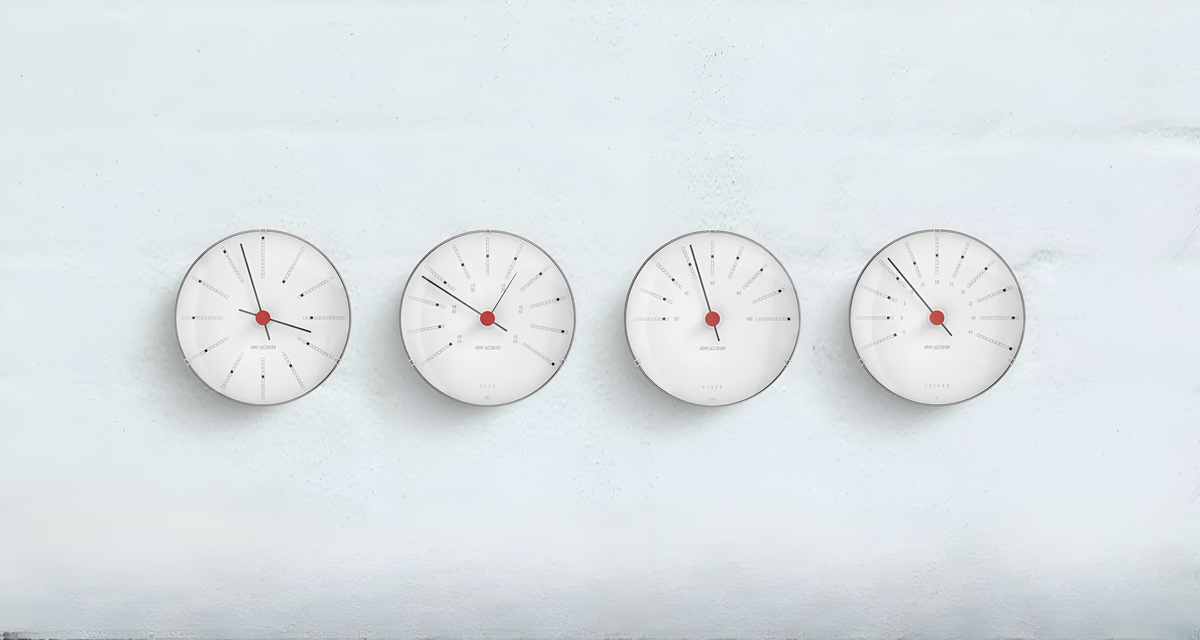
The Bankers Weather Station designed by Arne Jacobsen stands as one of the most refined expressions of Danish modernism. It is not simply a collection of instruments, but a carefully composed system that measures time and climate with equal clarity and dignity. Comprising a clock, thermometer, barometer, and hygrometer, the Bankers Weather Station embodies Jacobsen’s architectural mindset, where every element belongs to a unified whole.
More than five decades after its origin, the Bankers Weather Station continues to feel current, meaningful, and quietly authoritative. It exists beyond fashion, rooted instead in principles that remain relevant across generations.
This article explores the history, concept, and enduring relevance of the Arne Jacobsen Bankers Weather Station. It traces its origins from early modernist design principles, explains why it is time proof, and examines how its values will continue to resonate in the future. For collectors, architects, and admirers of Scandinavian design, this object represents a rare balance between utility, restraint, and visual intelligence.
The Origins of the Bankers Weather Station Design
To understand the Bankers Weather Station, one must begin with Arne Jacobsen himself. Born in Copenhagen in 1902, Jacobsen was trained as an architect, not as a product designer. This distinction is fundamental. He approached objects the same way he approached buildings, as integrated systems rather than isolated artifacts.
Jacobsen emerged during the rise of modernism, a movement driven by rationality, function, and social responsibility. Influenced by Bauhaus thinking and Nordic craftsmanship, he believed that design should serve people quietly and efficiently, without excess.
In 1971, Jacobsen was commissioned to design the National Bank of Denmark. His responsibility extended far beyond the building itself. He was tasked with creating a complete visual environment, including furniture, signage, lighting, and wall clocks.
It was within this context that the Bankers Clock was born.
The clock introduced a graphic language defined by bold linear markers, strong contrast, and impeccable legibility. Numerals were removed entirely. Time was expressed through structure rather than symbols. The result conveyed precision, authority, and calm.
This visual system would later become the foundation for the entire Bankers instrument family, including the weather station.
From Timekeeping to Environmental Awareness
The inclusion of a clock instrument within the Bankers Weather Station is not incidental. Time and weather are deeply connected. Both govern daily life, decision making, and rhythm.
Jacobsen understood that measuring climate without acknowledging time would feel incomplete. Weather unfolds across hours and days. Atmospheric pressure shifts slowly. Temperature changes follow cycles. The clock provides the temporal framework within which climate data gains meaning.
As a result, the Bankers Weather Station typically consists of four coordinated instruments:
- Clock
- Thermometer
- Barometer
- Hygrometer
Each instrument shares the same diameter, graphic language, and visual weight. Together, they form a balanced composition that feels architectural rather than decorative.
This system-based approach reflects Jacobsen’s belief that design should organize information, not merely present it.

Concept and Design Approach
The conceptual strength of the Bankers Weather Station lies in its disciplined reduction. Nothing is arbitrary. Every decision serves clarity and coherence.
Clarity as a Design Ethic
Jacobsen believed that clarity was a moral responsibility. The instruments use high contrast black and white surfaces, allowing readings to be understood instantly.
This clarity becomes especially important when multiple instruments are displayed together. The eye moves effortlessly from clock to barometer to thermometer without visual fatigue.
Typography as Structure
The typographic system used across the Bankers series feels architectural. The markers resemble load bearing elements. They suggest stability and order.
Typography here is not graphic decoration. It is functional architecture on a micro scale. This is one of the reasons the design continues to feel relevant. It communicates through proportion rather than style.
Balance Between Precision and Calm
Despite their technical purpose, the instruments never feel cold. The spacing, proportions, and pacing of information create a sense of calm presence.
This balance reflects a core principle of Danish modernism. Objects should support daily life without demanding attention.
Historical Context and Design Heritage
These pieces of design belongs to a long tradition of scientific instruments. Historically, clocks, barometers, and thermometers were often ornate, symbolic objects associated with authority and knowledge.
Jacobsen reinterpreted this heritage for a democratic society. Instead of ornament, he offered intellectual honesty. Instead of symbolism, he offered usability.
During the mid 20th century, Scandinavian countries became global leaders in human centered design. Products were meant to last, to be understood, and to age gracefully.
The Bankers instruments align perfectly with this cultural movement. They were originally created for an institutional setting, yet their clarity made them suitable for homes, studios, and workplaces.
Today, the continued production of the Bankers Weather Station by Rosendahl Design Group ensures that the original design remains intact, respected, and accessible.
Why the Bankers Weather Station Is Time Proof
Many designs lose relevance because they rely on stylistic signals tied to a specific era. The Bankers Weather Station avoids this fate by grounding itself in universal principles.
Time and Weather Are Eternal Concerns
The inclusion of the clock reinforces the station’s timeless relevance. Humans will always need to understand time and climate. While digital tools provide instant data, they lack physical presence.
If offers a slower, more reflective relationship with information.
Visual Restraint Ensures Longevity
The black and white palette transcends trends. It integrates seamlessly into changing interiors without losing identity.
This restraint allows the object to age with dignity rather than novelty.
Designed as a System, Not a Product
Jacobsen’s architectural approach ensured that the clock and weather instruments function as a cohesive whole. Systems endure because they can adapt to context without losing coherence.
The Bankers Weather Station remains visually complete whether displayed as a full set or as individual instruments.
Material Quality and Craftsmanship
Beyond graphics, material integrity plays a crucial role in the design’s longevity. The cases, glass, and mechanical components are chosen for durability and precision.
Jacobsen believed that objects should be maintainable, not disposable. This philosophy aligns strongly with contemporary concerns about sustainability and responsible consumption.
Owning a Bankers Weather Station is not about replacement. It is about continuity.
Relevance in Contemporary Design Culture
In recent years, there has been a renewed appreciation for analog objects. Mechanical watches, printed books, and tactile tools are valued for their presence and authenticity.
The Arne Jacobsen Bankers Weather Station fits naturally into this cultural shift. The clock anchors daily rhythm. The weather instruments encourage observation rather than distraction.
For younger generations, the design represents honesty and depth. For experienced collectors, it represents continuity and trust.
Design education continues to reference Jacobsen’s work because it demonstrates how discipline creates freedom. Limited color, consistent form, and strict function result in an object that feels endlessly adaptable.
The Future of the Bankers Weather Station
Looking ahead, the relevance of the Bankers Weather Station appears secure. As environments become increasingly digital, physical instruments regain emotional value.
The inclusion of the clock ensures that the station remains a daily companion rather than a passive object. Checking the time and observing the weather become small rituals that reconnect users with their surroundings.
Sustainability further strengthens its future relevance. Objects designed to last decades support a more responsible relationship with material culture.
The Bankers Weather Station does not compete with technology. It complements it by offering something technology cannot replace: presence and permanence.
A Quiet Icon of Danish Modernism
The Bankers Weather Station does not seek attention. It earns it.
Its authority comes from intellectual clarity, architectural thinking, and deep respect for the user. These qualities place it firmly within Arne Jacobsen’s broader legacy, alongside his buildings, furniture, and urban designs.
Whether mounted in an office, a studio, or a private home, the station communicates trust and balance.
Final Thoughts
The Bankers Weather Station by Arne Jacobsen, with its integrated clock and weather instruments, is far more than a measurement tool. It is a coherent design system shaped by modernist ethics and Danish cultural values.
From its origins at the National Bank of Denmark to its continued relevance today, it has remained unchanged because it was never designed to follow fashion.
By uniting time and climate within a single visual language, the Bankers Weather Station reminds us that good design is about understanding life as a system.
As long as humans value clarity, rhythm, and thoughtful objects, the Bankers Weather Station will continue to feel not only appropriate, but essential.