
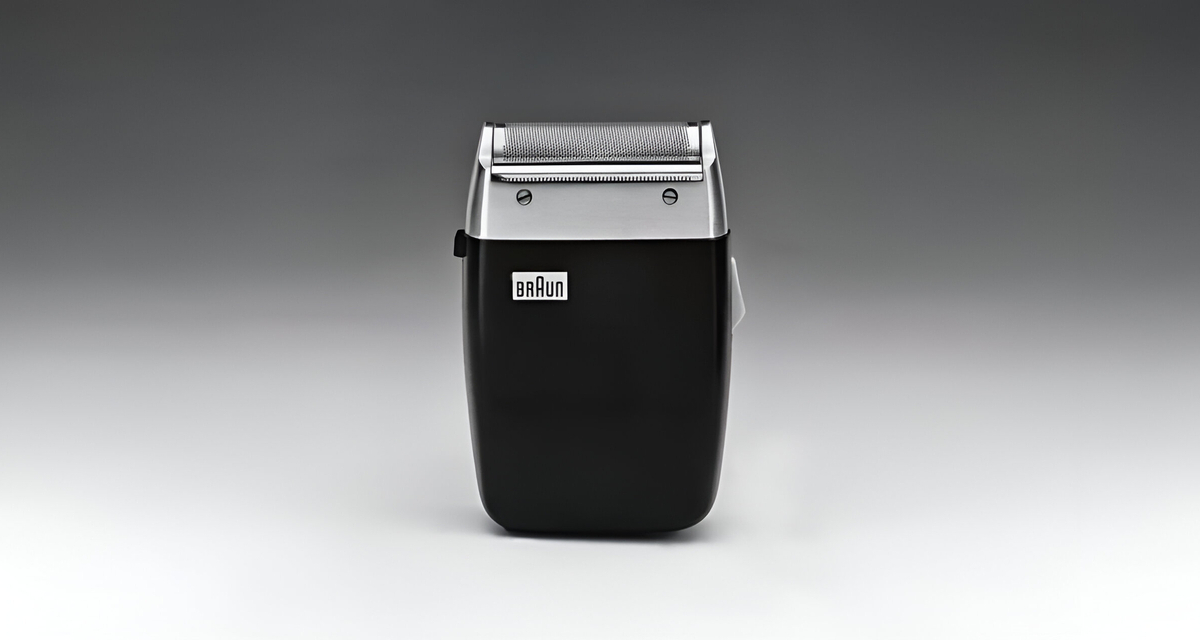
Introduced in the early 1960s, the Braun Sixtant SM 31 electric shaver did far more than remove stubble. It redefined how design, technology, and human behavior could align into a single, coherent object. Even today, the Sixtant SM 31 stands as a reference point for designers, engineers, and brand strategists who seek longevity rather than novelty.
This article explores the history of the Braun Sixtant SM 31 Shaver, the cultural and technological context that shaped it, the design philosophy behind its form, and why its principles remain relevant for the future of product design.
Moment That Gave Birth to the Braun Sixtant SM 31
The Sixtant SM 31 emerged in 1962, during a pivotal period in post war Europe. Germany was rebuilding its identity, industry, and confidence. At the same time, households were welcoming new electrical appliances that promised efficiency, hygiene, and modern living.
Braun, founded in Frankfurt in 1921, had already positioned itself as a company that valued engineering rigor. However, it was the arrival of Dieter Rams, who became head of design at Braun in 1961, that transformed the brand into a global design authority. Rams believed products should be understandable, honest, and useful. This philosophy became deeply embedded in the Sixtant SM 31.
Electric shavers existed before the Sixtant, but many were bulky, decorative, and visually aggressive. The Braun Sixtant SM 31 took a different path. It stripped the object down to its essence, presenting a calm, rational tool designed for daily use.
Design Origins and Influences
The visual language of the Braun Sixtant SM 31 Shaver emerged from Braun’s design department in the early 1960s, shaped by a collaborative culture rather than individual authorship. At the center of this environment was Dieter Rams, who became head of design at Braun in 1961 and established the principles that would define the company’s products for decades. Designers such as Gerd Alfred Müller played a direct role in translating these ideas into tangible consumer products, including Braun’s grooming devices and the Sixtant SM 31.
Equally important to the intellectual foundation of the Sixtant SM 31 was the influence of Hans Gugelot and contribution of Fritz Eichler. Although Gugelot was not a Braun employee, his work at the Ulm School of Design and his close collaboration with Braun during the 1950s profoundly shaped the company’s approach to form, systems thinking, and industrial logic. Gugelot’s emphasis on modularity, rational construction, and visual neutrality became deeply embedded in Braun’s design culture and informed the way products like the Sixtant were conceived.
The design was shaped by several key influences:
- The Ulm School of Design, where Hans Gugelot helped define a methodology centered on clarity, systems thinking, and functional reduction
- German engineering traditions focused on precision, reliability, and manufacturing discipline
- Modernist architecture, particularly the belief that form should arise directly from function
Under Rams’ leadership, and informed by Gugelot’s methodological rigor, Braun products rejected ornament and visual excess. Instead, they embraced legibility, modularity, and restraint. The Sixtant SM 31 embodied this approach with exceptional discipline.
Its rectangular body, gently rounded edges, and transparent protective cap formed a composition that felt neutral yet deliberate. Nothing was arbitrary. Every curve existed to support grip, balance, and usability, reinforcing Braun’s conviction that good design should be understandable, honest, and quietly confident.
The Concept and Approach Behind the Sixtant SM 31 Design
At the core of the Sixtant SM 31 was a clear design concept: make the function visible and intuitive.
The perforated metal foil, a key innovation, was not hidden. Instead, it became the visual and functional center of the product. This decision reflected Braun’s belief that users should understand how an object works simply by looking at it.
Key Design Principles
- Clarity over decoration
- Honesty in materials, using metal and plastic without disguise
- Human scale, designed to fit naturally in the hand
- Visual calm, avoiding visual noise or unnecessary graphics
The transparent cap deserves special mention. It protected the shaving head, but it also communicated hygiene and precision. The user could see the cutting surface, reinforcing trust in the tool.
This balance between engineering and visual simplicity turned the Sixtant SM 31 into an object that felt both technical and approachable.
Why the Braun Sixtant SM 31 Is a Time Proof Design
Many products age quickly because they follow trends. The Braun Sixtant SM 31 avoided this trap by focusing on fundamentals.
Timeless design does not chase attention. Instead, it earns respect over time. The Sixtant achieved this by adhering to principles that remain valid regardless of era.
Reasons for Its Longevity
- Functional minimalism that avoids stylistic excess
- Neutral geometry that resists visual aging
- High quality materials that age with dignity
- User centered logic that stays relevant as habits evolve
Importantly, the design does not attempt to impress. It supports the user quietly. As a result, it remains relevant even in a world saturated with digital interfaces and complex products.
The Braun Design Language and Its Broader Heritage
The Sixtant SM 31 did not exist in isolation. It was part of a broader Braun ecosystem that included radios, calculators, kitchen appliances, and audio equipment.
Products like the Braun SK 4 record player and the T 3 pocket radio shared the same DNA. Together, they established what many now call the Braun design language.
This language influenced generations of designers. Most notably, companies in Silicon Valley later adopted similar principles. The emphasis on restraint, grid based layouts, and user clarity can be seen echoed decades later in consumer electronics.
By maintaining consistency across products, Braun demonstrated that design systems, not individual objects, create lasting impact.
Historical Facts That Shaped the Sixtant Legacy
- The Braun Sixtant line was among the first to use foil shaving technology in a refined, user friendly form
- The SM 31 became widely adopted across Europe due to its reliability and ease of maintenance
- Museums such as MoMA later recognized Braun products as benchmarks of modern industrial design
- Dieter Rams’ philosophy, later summarized as the Ten Principles of Good Design, was already visible in the Sixtant
These historical facts reinforce why the Sixtant SM 31 is often studied in design schools and referenced in academic discussions about product longevity.
Materials, Manufacturing, and Engineering Integrity
Another reason the Braun Sixtant SM 31 Shaver remains admired is its manufacturing quality.
The materials were chosen not to impress visually, but to perform consistently. The casing balanced durability with tactile comfort. The metal foil was engineered for precision and easy replacement. Assembly favored modularity, allowing parts to be serviced rather than discarded.
This approach supported sustainability long before the term became fashionable. Products were expected to last, be repaired, and remain useful for years.
As a result, many original Sixtant shavers still function today, a rare achievement in consumer electronics.
Readability, Usability, and Human Factors
The Sixtant SM 31 excels in what designers now call human centered design.
The controls are minimal and clearly placed. The weight distribution feels balanced. The grip supports natural hand movement. Even the sound of the motor was considered, aiming for a calm and consistent tone rather than an aggressive buzz.
Because of this, the shaver feels intuitive even to first time users. There is no learning curve. This clarity reduces friction and builds trust.
Good design, after all, should disappear in use.
Why the Sixtant SM 31 Still Matters Today
In an era dominated by touchscreens, software updates, and visual overload, the Braun Sixtant SM 31 offers a counterpoint.
It reminds us that simplicity is not the absence of complexity, but the result of thoughtful reduction. Modern designers often reference Braun not to copy forms, but to learn how to prioritize.
Today’s interest in calm technology, sustainable products, and long lasting goods aligns perfectly with the values embedded in the Sixtant.
Its influence can be seen in:
- Minimal consumer electronics
- Modular product systems
- Brands that emphasize quiet confidence over marketing noise
The Future Relevance of the Braun Sixtant SM 31 Design Philosophy
While the original Sixtant SM 31 belongs to the past, its design philosophy belongs to the future.
As resources become more limited and users demand transparency, products will need to justify their existence. Designs that rely on surface novelty will fade. Designs rooted in purpose will endure.
The Sixtant teaches future designers to ask better questions:
- Does this feature serve the user?
- Can this form be reduced without losing meaning?
- Will this object age with dignity?
By answering these questions honestly, designers can create products that remain relevant for decades.
Final Thoughts: A Quiet Icon of Industrial Design
The Braun Sixtant SM 31 Shaver is more than a grooming device. It is a masterclass in restraint, clarity, and respect for the user.
Its historical context, thoughtful engineering, and disciplined aesthetics have secured its place as one of the most influential products in modern industrial design history.
In a world that often celebrates speed and spectacle, the Sixtant stands as a reminder that lasting design speaks softly but carries deep authority. Its relevance today, and tomorrow, proves that when design is guided by purpose and integrity, time becomes an ally rather than an enemy.
For designers, brands, and users alike, the Braun Sixtant SM 31 remains a guiding light for what truly timeless design can be.