
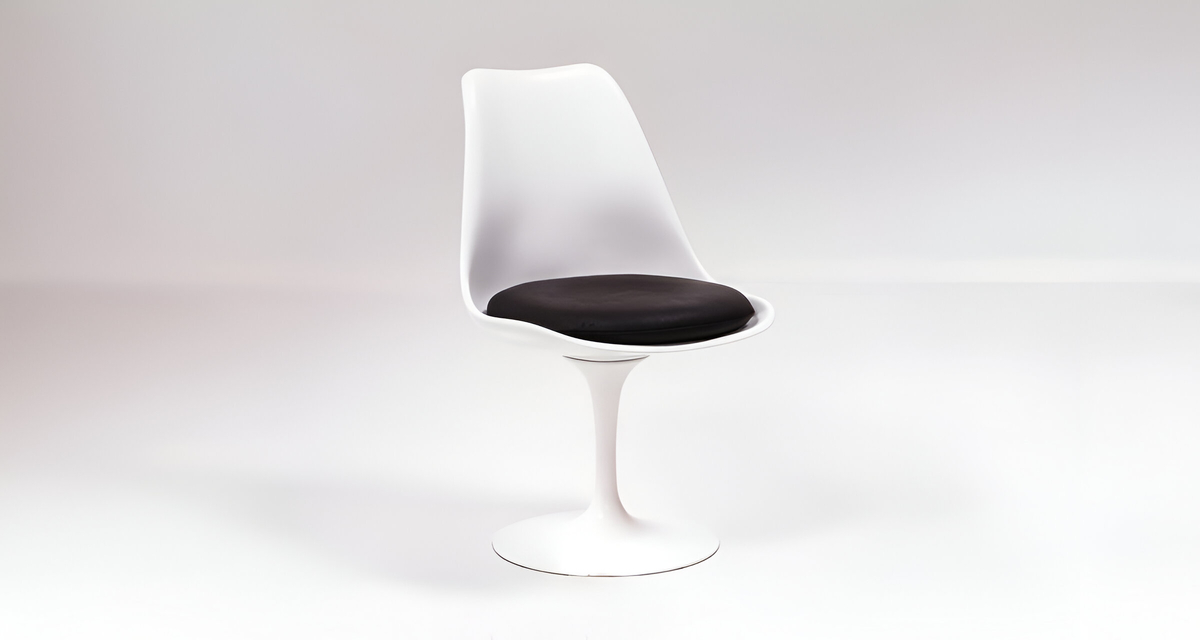
The Eero Saarinen Tulip Chair is a furniture idea made tangible, a sculptural response to chaos, and a symbol of modern optimism. Introduced in the mid twentieth century, the Tulip Chair remains one of the most recognizable and influential designs ever produced. Its presence feels as contemporary today as it did at its debut, appearing effortlessly in homes, offices, museums, films, and architectural icons around the world.
This article explores the history, concept, and enduring relevance of the Eero Saarinen Tulip Chair, tracing its origins from early design movements to its role in shaping the future of modern interiors. By understanding its story, we can better appreciate why this chair continues to attract designers, collectors, and everyday users alike.
Historical Context Behind the Eero Saarinen Tulip Chair
The Eero Saarinen Tulip Chair emerged during a transformative period in design history. The years following World War II were marked by technological progress, economic growth, and a desire to redefine how people lived. Design was no longer just about ornamentation. Instead, it focused on function, clarity, and new materials that reflected a forward looking society.
Eero Saarinen, born in Finland in 1910 and raised partly in the United States, was immersed in design from an early age. His father, Eliel Saarinen, was a celebrated architect and educator who helped shape American modernism. Growing up in this environment gave Eero a deep appreciation for architecture, sculpture, and the relationship between form and space.
By the early 1950s, Saarinen had already gained recognition for his architectural work and furniture collaborations. However, he was increasingly frustrated with what he described as the visual disorder created by traditional furniture. Tables and chairs with four legs created what he famously referred to as the slum of legs beneath dining tables.
This dissatisfaction became the conceptual seed for the Tulip Chair and Tulip Table.
The Design Concept: Eliminating Visual Noise
At the heart of the Tulip Chair design is a radical yet elegant idea. Saarinen sought to simplify the environment by reducing unnecessary visual complexity. His solution was deceptively simple. Remove the four legs and replace them with a single pedestal.
This approach was revolutionary at the time. While pedestal tables existed, chairs were still bound by centuries of tradition. Saarinen challenged this norm by treating furniture as sculptural architecture, rather than purely functional objects.
The Tulip Chair was designed as part of the Pedestal Collection, introduced in 1957 in collaboration with Knoll, a company that played a vital role in bringing modern design into American homes. The collection included tables and chairs unified by a single central base, creating visual harmony and spatial clarity.
The chair’s form resembles a flower emerging from the ground, which inspired its name. The organic silhouette offers both aesthetic beauty and ergonomic comfort, proving that innovation and usability can coexist.
Eero Saarinen Tulip Chair Materials and Manufacturing Innovation
One reason the Eero Saarinen Tulip Chair became a milestone in industrial design lies in its materials and production techniques. Saarinen envisioned a chair made from a single piece, but manufacturing limitations required a thoughtful compromise.
The base was crafted from cast aluminum, finished with a durable coating to maintain a consistent appearance. The seat shell was molded fiberglass, a material still relatively new in furniture design at the time. Fiberglass allowed Saarinen to achieve smooth curves and thin profiles without sacrificing strength.
The cushion, often upholstered in fabric or leather, added warmth and comfort while contrasting with the shell’s precision. This combination of materials reflected Saarinen’s belief that technology should serve human experience, not dominate it.
Knoll’s commitment to quality ensured that the Tulip Chair was not just experimental but also practical for mass production. This balance helped the design reach a wide audience and cement its place in everyday life.
Mid Century Modern Roots and Cultural Impact
The Tulip Chair is often associated with mid century modern design, a movement characterized by clean forms, functional thinking, and optimism about the future. Yet Saarinen’s work stood apart even within this context.
While many mid century designs emphasized straight lines and modularity, Saarinen embraced curves and fluidity. His approach was closer to sculpture than to traditional furniture making. This sculptural quality made the Tulip Chair a natural fit for modern architecture, especially open plan interiors that demanded visual coherence.
The chair quickly became a cultural icon. It appeared in magazines, exhibitions, and later in films and television, often used to signal futuristic or refined environments. Its inclusion in the Museum of Modern Art’s permanent collection further solidified its status as a design classic.
Importantly, the Tulip Chair did not remain frozen in time. It evolved with changing tastes, materials, and contexts, proving its adaptability across decades.
Why the Eero Saarinen Tulip Chair Is a Time Proof Design
A truly timeless design does not rely on trends. Instead, it addresses fundamental human needs and perceptions. The Eero Saarinen Tulip Chair succeeds because it operates on multiple levels.
First, its visual clarity remains relevant in an age of minimalism. As living spaces become more compact and multifunctional, furniture that reduces visual clutter is increasingly valued.
Second, its ergonomic intelligence ensures lasting comfort. Saarinen carefully studied how the human body interacts with seating, shaping the shell to support natural posture without excessive padding.
Third, the chair’s material honesty allows it to age gracefully. High quality production and thoughtful finishes mean that well maintained Tulip Chairs often look better with time.
Finally, the design’s emotional resonance plays a crucial role. It feels optimistic, calm, and balanced, qualities that transcend specific eras or styles.
Heritage From Early Design to Contemporary Use
The roots of the Tulip Chair can be traced back to early modernist ideas from Europe, including the Bauhaus emphasis on unifying art and industry. However, Saarinen expanded these ideas by embracing American manufacturing capabilities and cultural openness.
Over the decades, the Tulip Chair has been reinterpreted in countless interiors. It has appeared in formal dining rooms, creative studios, corporate offices, and public spaces. Its ability to adapt to different settings speaks to its design versatility.
Knoll continues to produce authentic versions of the chair, ensuring that Saarinen’s vision remains intact. At the same time, the design has inspired generations of designers to explore pedestal forms, organic geometry, and integrated systems.
In design education, the Tulip Chair is often studied as a case example of problem driven creativity, where a clear question leads to a groundbreaking solution.
The Tulip Chair and the Future of Design
Looking ahead, the principles embodied by the Eero Saarinen Tulip Chair align closely with the future of design. Sustainability, simplicity, and emotional connection are becoming central concerns for designers and consumers alike.
The Tulip Chair’s long lifespan supports sustainable thinking by encouraging durability over disposability. Its modular components allow for repair and reupholstery, extending its usable life far beyond typical furniture cycles.
Moreover, its emphasis on clarity of form resonates with future focused design philosophies that prioritize calm, adaptable environments. As technology becomes more pervasive, people increasingly seek spaces that feel human and grounding. The Tulip Chair answers this need without nostalgia.
Emerging designers continue to reference Saarinen’s work not by imitation but by embracing his mindset. Question assumptions. Identify real problems. Let form follow purpose.
Why the Eero Saarinen Tulip Chair Still Matters
The enduring success of the Eero Saarinen Tulip Chair is not accidental. It represents a rare alignment of vision, craftsmanship, and cultural timing. Saarinen did not design for attention. He designed for clarity.
In doing so, he created an object that feels at home in the past, present, and future. Its ability to remain relevant across generations proves that great design is not about decoration but about meaningful innovation.
Whether admired as a museum piece or used daily around a dining table, the Tulip Chair continues to remind us that thoughtful design has the power to shape how we live, move, and feel within space.
More than sixty years after its introduction, the Tulip Chair still blooms.
Final Thoughts
The Eero Saarinen Tulip Chair endures because it represents more than an aesthetic achievement. It is a clear expression of how design can respond to human needs, technological possibilities, and cultural aspirations at the same time.
Saarinen did not aim to create an icon. He aimed to solve a problem. In doing so, he produced a chair that feels as meaningful today as it did over sixty years ago.
Whether experienced as a daily companion or admired as a design milestone, the Tulip Chair continues to shape interiors, influence designers, and remind us that timeless design begins with thoughtful intent.