
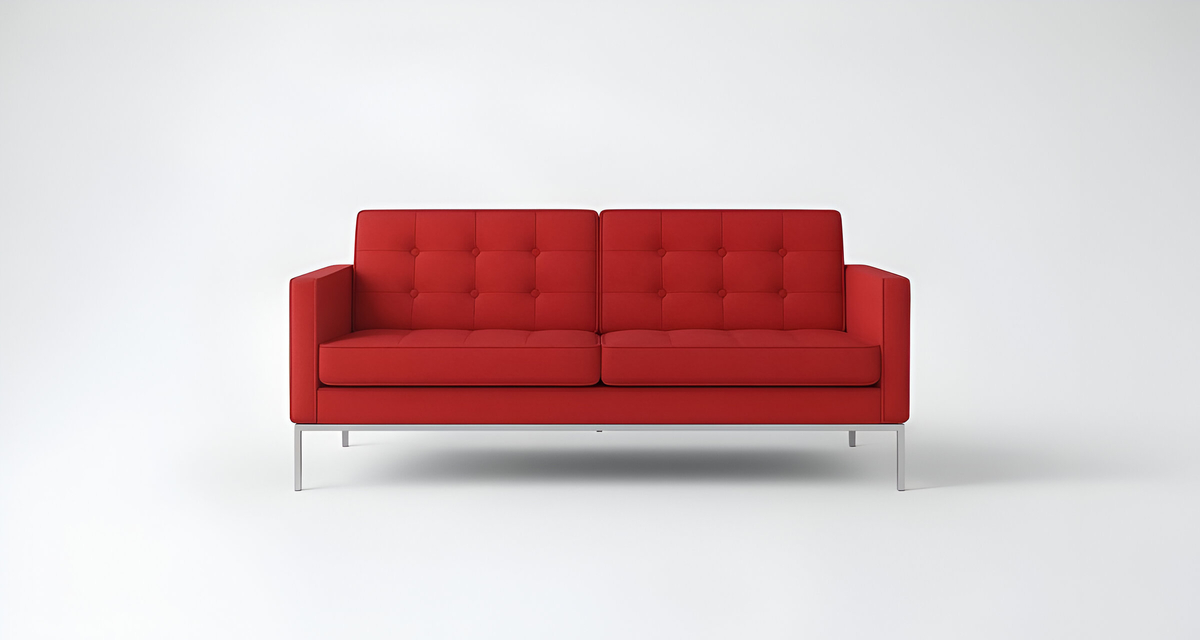
The Florence Knoll Sofa carry a resonance, influence, and enduring elegance in the vast history of modern furniture. Born in the mid-20th century, this sofa is not merely a seating solution. It is the physical embodiment of modernist ideals, a piece that integrates architecture, art, and design into one harmonious whole.
To understand why this sofa remains as relevant today as when it was first introduced, we must trace its roots, its philosophy, and its continued relevance in contemporary living spaces.
The Origins of the Florence Knoll Sofa
Florence Knoll, trained as an architect and educated under the guidance of legendary figures such as Mies van der Rohe and Eliel Saarinen, approached furniture design differently from many of her contemporaries. She was not a stylist chasing trends, but rather a problem solver who used furniture as an extension of architectural planning. When Knoll designed her sofa in 1954, she did so with the precision and restraint of an architect.
Her aim was not to create a decorative object, but a piece that embodied order, function, and proportion. The Florence Knoll Sofa was part of what she herself humbly referred to as the “meat and potatoes” of furniture design, essentials that supported rather than overpowered a room. Yet ironically, in this modesty lies its brilliance: by resisting excess, Knoll crafted a sofa that has endured for over seventy years and will continue to do so.
The origins of the sofa align with the mid-century modern movement that emphasized clarity, functionality, and honesty in materials. While other designs from the era celebrated organic curves or flamboyant details, the Florence Knoll Sofa embraced rational geometry, right angles, and refined detailing. Its form reflected her architectural sensibility, translating the language of the International Style into upholstered comfort.
Design Concept and Approach
The Florence Knoll Sofa exemplifies the idea that simplicity, when executed with rigor and precision, achieves a form of quiet sophistication that never fades. Every line, every seam, and every proportion in the sofa reflects deliberate calculation.
The sofa is built on a rectilinear frame resting on slender steel legs, giving it a lightness that balances its volume. The cushions are tailored with exactness, avoiding excess bulk. Knoll herself once said that she “did not design furniture for fun,” but rather to solve problems in space. This problem-solving attitude is why the Florence Knoll Sofa integrates seamlessly into homes, offices, galleries, and public spaces across decades and continents.
The concept of modularity also plays a role in its design. The sofa was not conceived as a solitary star piece but as part of a larger system of furniture that could adapt to different spaces. Knoll understood that the modern environment required flexibility, and her sofa was designed to serve equally well in intimate residential settings or vast corporate lobbies.
Historical Context and Heritage
The 1950s were a period of great transformation. Postwar optimism fueled rapid growth in architecture and urban planning. Companies and individuals alike sought environments that reflected progress, efficiency, and modernity. Florence Knoll, working with Knoll Associates, revolutionized interior planning by introducing what she called the “Knoll Planning Unit“, a pioneering approach to integrated interior design.
In this context, the Florence Knoll Sofa was not just a furniture piece but a building block in creating modern interiors. Alongside other icons like the Barcelona Chair by Mies van der Rohe, the Womb Chair by Eero Saarinen, and the Tulip Table, the sofa helped establish a vocabulary of modern design that still defines interiors today.
Knoll herself was an extraordinary figure. A woman in a field dominated by men, she redefined how we think about both furniture and space. The Florence Knoll Sofa is not only a design object but also a historical marker of her influence and vision.
Why the Florence Knoll Sofa is a Time-Proof Design
Timelessness in design arises when function and form align so perfectly that they transcend cultural and temporal shifts. The Florence Knoll Sofa achieves this balance. Its rational geometry, combined with its versatility, allows it to fit effortlessly into almost any environment, whether minimalist, eclectic, or traditional.
The sofa avoids the trap of being bound to an era. While many mid-century pieces clearly reflect the 1950s aesthetic, the Florence Knoll Sofa feels perpetually contemporary. Its clean silhouette pairs just as well with cutting-edge interiors of today as it did with the postwar corporate offices of the 1950s.
Its materiality is another factor in its longevity. Originally produced with high-quality upholstery and polished steel legs, the sofa embodied durability and refinement. Contemporary versions continue this tradition, offering a wide range of textiles and finishes that adapt to evolving tastes while maintaining the integrity of the original design.

Examples of Timeless Models by Florence Knoll
The Florence Knoll Sofa is part of a broader family of designs by Florence Knoll that share its enduring qualities. Her Florence Knoll Lounge Chair, with its matching rectilinear proportions and tailored cushions, complements the sofa and is equally timeless.
Another example is the Florence Knoll Coffee Table, which features a simple yet precise glass or marble top on steel legs. Like the sofa, it integrates into spaces without dominating them, proving that restraint often results in lasting relevance.
Collectively, these designs demonstrate Florence Knoll’s philosophy that good design is about utility and proportion, not excess decoration. By focusing on the essentials, she created furniture that remains fresh across generations.
The Influence of Early Designs on the Sofa
The Florence Knoll Sofa did not emerge in isolation. It is deeply connected to the teachings of the Bauhaus movement, which emphasized the unification of art, craft, and industry. Knoll studied under some of the greatest minds of modernism, absorbing the Bauhaus principle that design should be both beautiful and functional.
We also see the influence of Mies van der Rohe’s dictum “less is more” in the sofa’s restrained lines. The steel legs echo his use of industrial materials, while the emphasis on proportion and structure reflects architectural thinking.
This heritage connects the sofa to a larger narrative of modernism, placing it alongside icons like the LC2 sofa by Le Corbusier, yet distinguished by Knoll’s unique architectural approach and sensitivity to interior space.
Relevance Today
Why does the Florence Knoll Sofa still captivate designers, architects, and homeowners in 2025? Because it offers something rare: a design that adapts without losing its identity.
In today’s interiors, where styles shift rapidly and eclectic mixes dominate, the Florence Knoll Sofa serves as an anchor. Its clarity provides balance in spaces filled with varied textures, colors, and objects. It also continues to embody values that resonate deeply today: sustainability, longevity, and authenticity.
Unlike disposable furniture, the Florence Knoll Sofa is an investment in enduring quality. Its continued production by Knoll, using materials and craftsmanship of the highest standard, ensures that it is not just a relic of design history but an active participant in contemporary living.
The Future of Timelessness
Looking forward, the Florence Knoll Sofa will remain relevant for the same reasons it has endured until now. As design increasingly grapples with questions of sustainability and environmental responsibility, the emphasis on durability and timelessness becomes essential. Furniture that resists obsolescence by virtue of its form and quality naturally aligns with the values of a conscious future.
The Florence Knoll Sofa embodies universal design principles: geometry, proportion, and clarity. These are not trends, they are constants in human perception. Just as classical architecture continues to inspire, so too will this sofa remain a touchstone for modern living.
Final Thoughts
The Florence Knoll Sofa is far more than a piece of mid-century furniture. It is a manifestation of modernist ideals, a reflection of Florence Knoll’s architectural precision, and a design that has transcended time. From its origins in the 1950s to its place in today’s interiors, it has proven that restraint, proportion, and clarity result in designs that endure across generations.
Its heritage links it to the Bauhaus and the International Style, while its future relevance lies in its adaptability and timelessness. Alongside other models in the Florence Knoll collection, the sofa continues to demonstrate that furniture designed with honesty, precision, and purpose will never fade into obsolescence.
The Florence Knoll Sofa is not only an icon of design history but also a guide for the future of furniture: a reminder that true timelessness is achieved when function, form, and integrity unite in perfect harmony.