
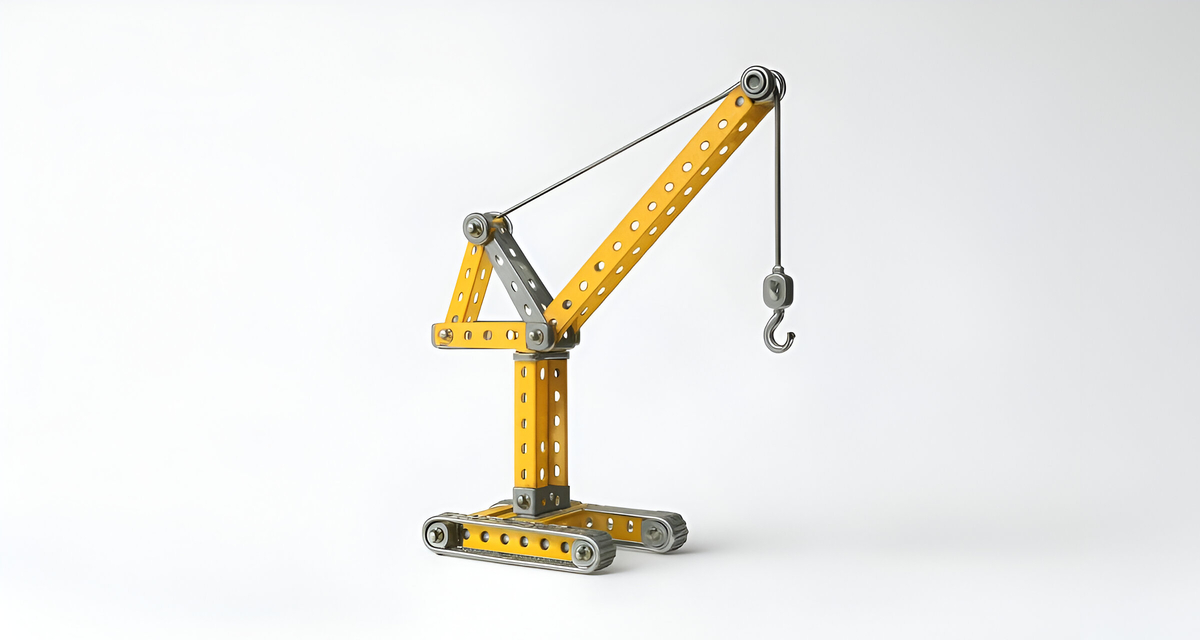
The Meccano Construction Set is among the many inventions that have shaped childhood creativity, with enduring relevance and mechanical elegance. For over a century, Meccano has captivated generations with its modular engineering system, offering an open-ended invitation to build, learn, and imagine.
What began as a simple homegrown teaching tool in the early 1900s has become a global symbol of mechanical ingenuity. The appeal of Meccano transcends age, technology, and even culture. It is at once a toy, a teaching instrument, a historical artifact, and a creative medium.
To understand why the Meccano Construction Set has lasted so long, and why it will continue to inspire well into the future, we must explore its origin story, its design philosophy, its role in education, and the remarkable community and heritage it has built around the world.
Meccano Construction Set Origin Story
The year is 1898. Frank Hornby, a Liverpool clerk, is tinkering with small metal strips on his kitchen table. Hornby is not an engineer by training, but he has a sharp mind and a knack for solving practical problems. He wants to teach his children how machines work, not through diagrams, but through hands-on building.
His breakthrough comes when he standardizes the spacing of holes in metal strips. This allows different parts to be joined with small nuts and bolts in endless configurations. By 1901, Hornby patents the idea under the name “Mechanics Made Easy.” The first sets are rudimentary: steel strips, a few plates, some gears, wheels, and axles. Yet their expandability is revolutionary.
The Birth of a Brand: Meccano
In 1907, Hornby rebrands his invention as Meccano, a name drawn from the phrase “Make and Know.” The branding is deliberate: Meccano is not about building for the sake of building; it is about building to learn.
By standardizing every component, hole spacing, bolt size, gear pitch, Hornby ensures permanent compatibility between parts, regardless of production year. This means a strip from 1907 will still fit perfectly with one from 2025. In the design world, this level of forward and backward compatibility is rare and visionary.
Early Global Expansion
By 1914, Meccano has moved far beyond Liverpool. Factories open in France, Spain, and the United States to keep up with demand. The company also launches the Meccano Magazine in 1916, a monthly publication filled with building plans, technical tips, and news from the growing Meccano community.
The magazine transforms Meccano from a toy into a movement. Builders from different countries share their creations, inspiring others and fostering a global network of mechanical creativity long before the internet existed.
Meccano Construction Set Time-Proof Design Principles
What makes the Meccano Construction Set a time-proof design is a blend of practical engineering and conceptual foresight:
- Modularity – Every part is designed to work with every other part, regardless of production year or country of origin.
- Mechanical Authenticity – Components like gears, pulleys, and axles are not ornamental, they function exactly as they would in full-scale machines.
- Durability – Early Meccano parts are made of quality steel and brass, capable of lasting over a century with minimal wear.
- Open-Ended Creativity – There is no “right” final model; the system is designed for infinite exploration.
- Educational Value – Every build teaches principles of physics, engineering, and problem-solving.
This combination ensures that Meccano doesn’t become outdated. Unlike toys tied to fleeting pop culture trends, Meccano taps into universal mechanical truths.
Meccano Through the Decades
1900s–1920s: Industrial Inspiration
The world is in awe of bridges, steam locomotives, and towering cranes. Meccano reflects this era’s mechanical optimism. Sets allow builders to create working models of these wonders, complete with moving parts.
1930s–1940s: Resilience Through Hard Times
During the Great Depression and World War II, Meccano faces material shortages but survives. Some sets are simplified, yet the educational core remains strong.
1950s–1960s: Color and Accessibility
Post-war prosperity sees Meccano adopting brighter colors and expanding into mass markets. The sets become staples in classrooms and households alike.
1970s–1980s: Electric Motors and New Materials
Electric motors and some plastic components are introduced. While purists miss the all-metal kits, these innovations make Meccano more accessible to younger builders.
1990s–2010s: Robotics and STEM
Meccano embraces programmable electronics, remote control systems, and robotics kits. It becomes a recognized tool in STEM education, teaching coding alongside mechanical design.
2020s and Beyond: Tradition Meets Technology
Today, Meccano offers app-guided building, augmented reality integration, and advanced robotics, all while keeping the classic bolt-and-strip foundation intact.
The Meccano Construction Set Building Philosophy
The Meccano system is essentially a mechanical language. The perforated strip is the alphabet; brackets, plates, and gears are the grammar; bolts and nuts are the punctuation. With these basic elements, builders can “write” mechanical sentences of infinite complexity.
This approach mirrors real-world engineering. Each part can serve multiple purposes: a plate might be a chassis base, a bridge deck, or the wall of a crane cab. This adaptability teaches flexible thinking, a vital skill in engineering and design.
Educational Power: Meccano in Schools and Beyond
For over a century, the Meccano Construction Set has been used as a teaching tool to introduce concepts such as:
- Structural design – Why triangles make bridges strong.
- Leverage and torque – How mechanical advantage works in cranes.
- Transmission of motion – The role of gears and belts.
- Creative problem-solving – Iterating designs to overcome real constraints.
Today, Meccano is part of many STEM programs, from elementary schools to university engineering clubs. Its hands-on learning bridges the gap between theory and practice in a way that no screen-based app can.
Iconic Meccano Models Through Time
While Meccano is designed for open creativity, some models have become legendary benchmarks:
- Tower Bridge – A faithful, working miniature of London’s iconic landmark.
- Ferris Wheel – Showcases rotational mechanics and balance.
- Steam Locomotive – Complete with moving rods and wheels.
- Eiffel Tower – A metal lattice masterpiece demonstrating structural engineering.
- Dockside Crane – A fully operational model of industrial lifting technology.
These builds endure because they combine mechanical accuracy with the thrill of seeing something truly functional emerge from simple parts.
The Collector’s World
Vintage Meccano sets, especially those from the early 20th century, are highly collectible. Complete sets in original boxes can command significant prices. Collectors often restore old models to working condition, proving the longevity of Meccano parts.
International Meccano clubs host exhibitions where builders present jaw-dropping models: working clocks, massive cranes, even scale-model roller coasters, all crafted entirely from Meccano pieces.
Meccano’s Place in Modern Culture
Even in the digital era, Meccano retains a presence in popular culture. It appears in museums, design exhibitions, and even in art installations. Some professional engineers credit their career choice to childhood experiences with Meccano.
The construction set also finds its way into maker spaces and prototyping labs, where its modularity allows for quick mock-ups of mechanical systems.
The Future of Meccano Construction Set
Looking ahead, Meccano is poised to remain relevant by blending its mechanical heritage with new technologies:
- Robotics integration with AI-powered control.
- 3D printing compatibility for custom parts.
- Augmented reality instructions for immersive building guides.
- Sustainably sourced materials to appeal to environmentally conscious builders.
However, the magic will remain in the physical act of creation: tightening a bolt, aligning a gear, watching a pulley lift a load.
Why Meccano Will Never Go Out of Style
The enduring relevance of the Meccano Construction Set lies in its ability to connect past, present, and future. It embodies the spirit of invention, the satisfaction of problem-solving, and the joy of making. As long as humans are fascinated by how things work, Meccano will continue to find its place in classrooms, workshops, and living rooms around the world.
It is more than just a toy. It is a mechanical legacy, a design heritage, and a creative toolbox for the next century and beyond.