
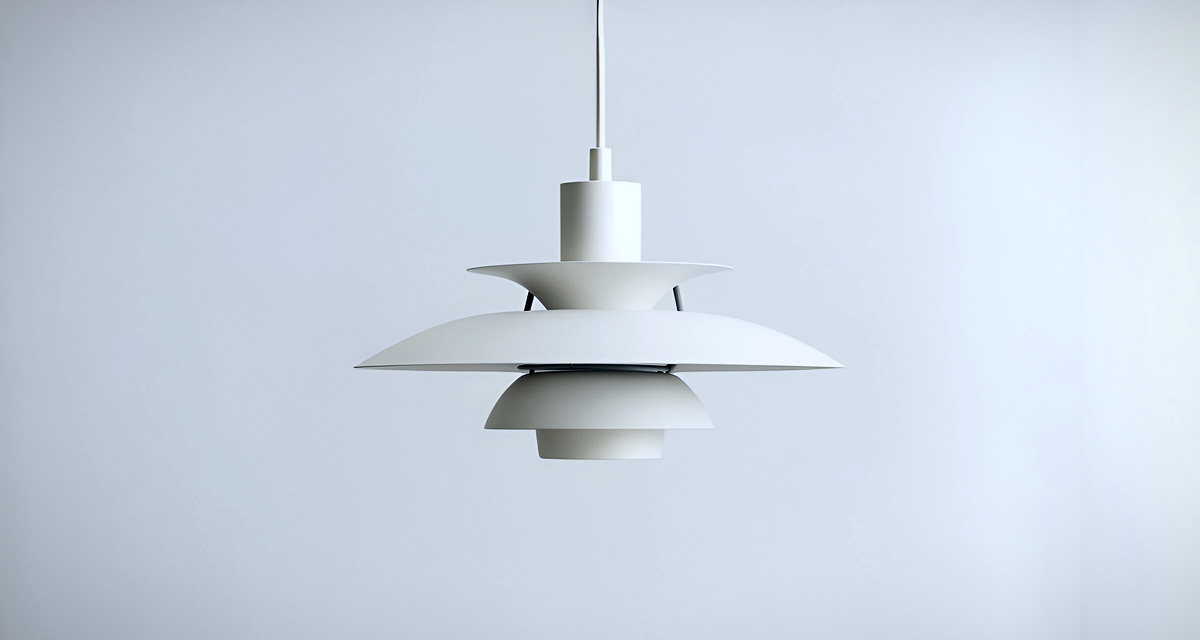
In the pantheon of 20th-century design, few objects hold the quiet power and enduring legacy of the PH Lamp. Created by the brilliant Danish designer Poul Henningsen, this lighting masterpiece has transcended trends, generations, and continents, becoming one of the most iconic symbols of Scandinavian design philosophy. Rooted in a blend of functionality, humanism, and artistic clarity, the PH Lamp as a lighting fixture, is an intellectual and emotional expression of light, space, and atmosphere.
This article explores the origin, evolution, and timeless relevance of the PH Lamp. Along the way, we’ll discover how Poul Henningsen’s design approach changed how we understand light and why his work remains as relevant today as it was nearly a century ago.
The Origins of the PH Lamp: A Revolution in Light
To understand the PH Lamp’s place in design history, we must return to Copenhagen in the 1920s. At the time, artificial lighting was undergoing a major transition. Electric light had arrived, but it was harsh and unrefined, often casting glaring shadows or overpowering rooms. Enter Poul Henningsen, a visionary thinker, writer, and designer who believed that light should be gentle, human, and harmonious with its surroundings.
In 1924, Henningsen began experimenting with a multi-shade lamp system that would diffuse light evenly, eliminating glare while still allowing a room to feel warm and illuminated. These experiments led to the development of the first PH lamp, a three-shade system that utilized carefully calculated geometric relationships to control how light was distributed. This approach was mathematically precise, but the result felt instinctive and natural.
The PH Lamp was officially unveiled at the 1925 International Exhibition of Decorative Arts in Paris, receiving a gold medal. It wasn’t just a design; it was a revelation. For the first time, a lamp had been created that didn’t just emit light, it shaped it.
Poul Henningsen’s Design Philosophy: Light for People
Poul Henningsen was a designer, a cultural critic, a poet, and a deeply political individual, who viewed design as a tool for social change. He believed that design should serve the needs of people, not industry, not fashion, not markets. The PH Lamp was his way of humanizing the modern world through something as ordinary and essential as light.
Central to his philosophy was the idea of “human light”, a concept that prioritized visual comfort, emotional resonance, and atmosphere over mere brightness. Henningsen’s lamps didn’t just light rooms; they created moods. They allowed people to see each other more naturally, to dine in soft intimacy, to work without strain, and to live without being assaulted by light.
His dedication to this ideal led him to develop hundreds of lamp models, each tailored to different uses, environments, and technologies. But no matter the form, each carried the same DNA: layered shade systems, glare-free lighting, and a poetic sense of balance.
The Multi-Shade System: A Technical and Emotional Breakthrough
At the core of the PH Lamp design is its three-shade system, later expanded into four or more in some variations. These shades, typically made of metal or opal glass, are designed to reflect light downward and sideways in a controlled, diffused manner.
The geometry is no accident. Henningsen used logarithmic spirals to calculate the precise curves of each shade, ensuring that light was distributed in a soft, even glow. This approach was revolutionary at the time. It allowed the lamp to eliminate direct glare, a common problem with early electric lights, while also enhancing the aesthetic beauty of the fixture itself.
This wasn’t just about physics, it was about feeling. The PH Lamp’s light feels calm and deliberate, as if it understands the room it’s in. It supports conversation, contemplation, and creativity. That’s why it’s found in homes, museums, restaurants, libraries, and even churches.
From the PH 5 Lamp to the Artichoke: Time-Proof Icons of Design
Several models in the PH series have become design classics, recognized globally for their beauty and intelligence. Among these, a few stand out as truly time-proof:
PH 5 (1958)
The PH 5 is arguably the most famous of all Henningsen’s lamps. Introduced in 1958 in response to changes in lightbulb technology, the PH 5 was designed to accommodate any type of light source, a forward-thinking decision that extended its relevance well into the future.
Its design uses five carefully proportioned shades, which result in a balanced, shadow-free glow. It is equally suited for dining tables, living rooms, or modern workspaces. The PH 5 has never gone out of production, a rare feat in the world of industrial design.
PH Artichoke (1958)
Also designed in 1958, the PH Artichoke is a masterwork of sculptural lighting. Composed of 72 individual “leaves” arranged in a radial pattern, the Artichoke provides 360-degree illumination without glare. It is a statement piece, often found in grand spaces like theaters, concert halls, or sophisticated interiors.
Yet despite its visual drama, it retains the same fundamental principles as the original PH Lamp: comfort, control, and a deep respect for human experience.
PH Snowball
Less known than the PH 5 or Artichoke, the PH Snowball is a stunning example of layered design and harmonious proportion. Its combination of symmetry and softness makes it especially popular in minimalist interiors that prioritize light quality as much as form.
The Craft of Light: Materials, Colors, and Meaning
Over the decades, the PH Lamp has been produced in various materials and finishes, but its soul has remained intact. Originally made in metal and glass, newer editions offer options in brushed aluminum, copper, brass, and even colored lacquer, adapting the design to different environments without losing its essence.
Color is another layer of the lamp’s thoughtful design. Poul Henningsen was acutely aware of how light interacts with surfaces, so even the interior color of the shades is often customized to enhance the warmth or neutrality of the emitted light.
In a world where lighting often feels disposable or over-engineered, the PH Lamp’s approach remains grounded in craft, purpose, and timeless restraint.
Why the PH Lamp Is Timeless: Beyond Style and Trend
Design trends come and go, but the PH Lamp endures because it answers a universal and eternal need. There is a desire for light that supports, rather than dominates, our lives.
Its timelessness lies in its utility, its elegance, and its deep understanding of human perception. While many lighting designs chase novelty, the PH Lamp resides in permanence, precisely because it was never about being fashionable. It was about being right.
This philosophy has allowed the PH Lamp to live comfortably across styles, from mid-century modern homes to cutting-edge architecture. From the tables of Danish households to the halls of international design museums.
Designers, architects, and lighting specialists continue to reference Henningsen’s work as the benchmark for human-centered lighting. It’s taught in schools, studied in journals, loved by those who live with it.
The Future of PH Lamps: Relevance in a Changing World
As we move into a future dominated by smart technologies and sustainable materials, the PH Lamp remains astonishingly relevant. Its modular construction, long lifespan, and adaptability make it an ideal model for circular design principles.
Brands like Louis Poulsen, the official manufacturer of PH lamps since the beginning, continue to honor Poul Henningsen’s legacy. Maintaining original specifications while exploring new materials, energy-efficient LED options, and finish variations.
In a digital world overloaded with visual noise, the PH Lamp offers an oasis of calm. Its relevance grows not by changing with time but by standing firm against the impermanence of trend. It reminds us that true design doesn’t need to shout, it simply needs to work, to last, and to matter.
More Than a Lamp, a Legacy
The PH Lamp is not just an object of beauty or utility. It is a philosophy made physical, a cultural artifact that tells the story of 20th-century modernism, Danish innovation, and human-centered design.
Poul Henningsen didn’t just design lamps. He reshaped how we think about light, about comfort, and about the spaces we inhabit. His legacy lives on in every PH Lamp, quietly illuminating lives with the same grace, intelligence, and purpose it did in 1925.
So when you see a PH Lamp, be it a modest PH 5 above a dining table or a majestic Artichoke in a grand hall, know that you’re not just looking at a product. You’re experiencing a piece of design history that continues to shine, in every sense of the word.