
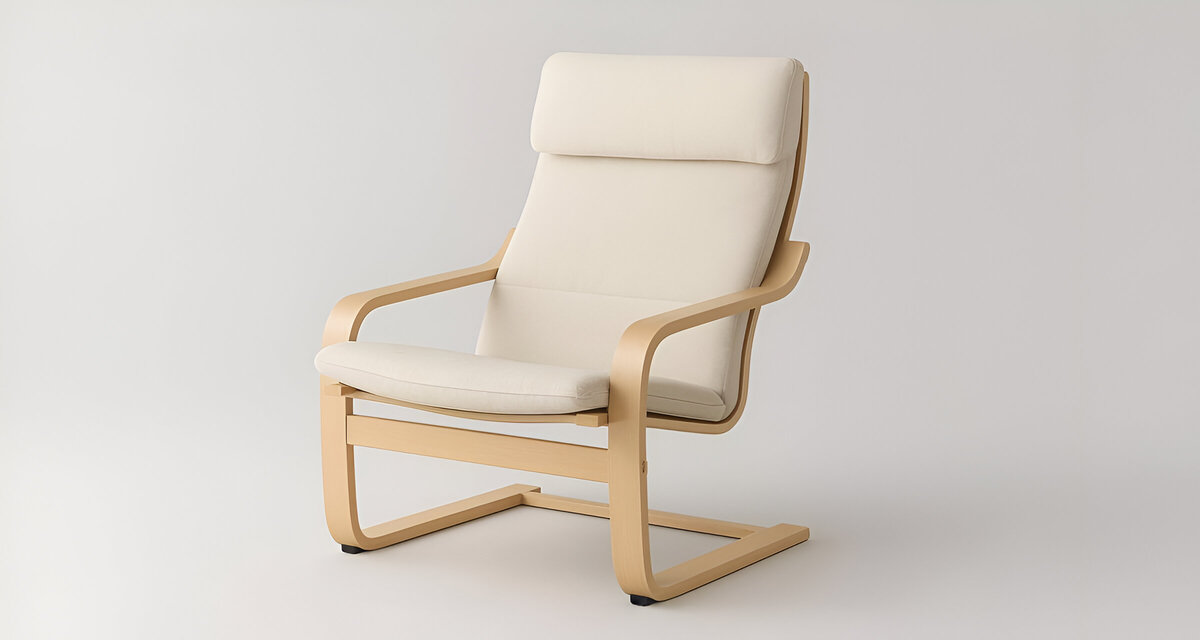
Few objects in the world of furniture have managed to transcend decades with the same quiet confidence as the IKEA Poäng armchair. This chair is more than a piece of furniture: it is a cultural artifact, a bridge between Scandinavian design philosophy and the everyday lives of millions of people around the globe. Since its introduction in the 1970s, the Poäng has remained one of the most recognizable and beloved chairs ever created, embodying a balance of comfort, affordability, and enduring design relevance.
At first glance, the Poäng may appear deceptively simple. Its bentwood frame curves with a natural rhythm, cradling the body in a way that feels both inviting and supportive. Yet behind its approachable appearance lies a story of innovation, experimentation, and deep roots in the traditions of modern Scandinavian design. The Poäng armchair is not simply a product of its time, it is an object that has outlived countless trends and will continue to do so because of its unique approach to both form and function.
The Origins of the Poäng Armchair
The Poäng story begins in 1976, when Japanese designer Noboru Nakamura, working in collaboration with IKEA’s visionary founder Ingvar Kamprad, introduced the chair under the original name “Poem.” Nakamura was deeply inspired by the ideals of modernism, which prioritized functional beauty, accessible design, and the human experience of comfort. He drew upon the Scandinavian tradition of bentwood experimentation, a method pioneered earlier in the century by design icons such as Alvar Aalto, whose 1930s armchairs with curving laminated wood frames had already influenced a generation of designers.
Nakamura’s goal was not to create a status symbol but to make a chair that anyone could afford and live with for decades. The result was a piece that embodied Japanese simplicity and Scandinavian functionality. With its cantilevered form, the chair introduced a natural springiness, creating a gentle rocking motion that quickly became one of its defining features.
Over the years, the Poäng has been renamed, reinterpreted, and produced in countless upholstery variations, yet the essential form has remained unchanged. This consistency is one of the reasons the Poäng is now seen as a time-proof design. It was not built to chase short-lived trends but to respond to fundamental human needs: support, comfort, and aesthetic harmony.
Why the Poäng Armchair is a Time-Proof Design
The concept of time-proof design revolves around furniture that transcends fashion cycles, continuing to feel relevant decades after its creation. The Poäng achieves this through several key factors:
1. Human-Centered Comfort
Unlike many chairs that prioritize appearance over ergonomics, the Poäng was designed with the human body in mind. Its gently curving frame distributes weight evenly, while the slight flex of the bentwood creates a sensation of buoyancy. The high backrest offers crucial neck and head support, making it equally suitable for reading, watching television, or simply relaxing. Comfort is not subject to fashion, which makes the Poäng eternally appealing.
2. Modular Simplicity and Adaptability
The Poäng’s frame has remained nearly identical since the 1970s, yet the chair is offered in an evolving modular range of cushions, covers, and colors. This adaptability allows the chair to blend seamlessly into different interior styles, from minimalist apartments to eclectic living rooms. By updating only the textile elements, IKEA has ensured that the Poäng remains relevant to changing tastes without altering the integrity of its design.
3. Durability and Sustainability
The Poäng’s laminated wood frame is engineered to last for decades. IKEA has tested its resilience against thousands of hours of use, and many households still own Poäng chairs purchased in the 1980s or 1990s. In recent years, as sustainability has become a crucial factor in consumer choice, the Poäng has only grown more relevant. Its renewable wood construction and replaceable cushion covers align perfectly with the values of a future-conscious generation.
4. Affordability and Accessibility
While many timeless designs are associated with exclusivity, the Poäng’s genius lies in its accessibility. It has always been priced for ordinary households, not collectors. Yet this accessibility has not diminished its cultural value; rather, it has made the chair an icon of democratic design, proof that timelessness does not require luxury.
A Heritage Rooted in Design History
To fully appreciate why the Poäng has endured, it is important to place it within the broader history of 20th-century furniture design. Its lineage can be traced back to several pivotal innovations:
- Alvar Aalto’s Armchairs (1930s): Aalto pioneered the use of bent plywood to create resilient, organic forms. His Armchair 406, with its cantilevered birch frame, shares a clear kinship with Nakamura’s later design. Aalto’s work laid the foundation for furniture that felt both modern and human.
- Marcel Breuer’s Cantilever Chairs (1920s): While working at the Bauhaus, Breuer experimented with tubular steel to create the first truly cantilevered chairs. These designs introduced the radical idea that a chair could support weight without four rigid legs, directly influencing later explorations in wood and laminate.
- Scandinavian Functionalism (1950s–1960s): Designers such as Arne Jacobsen and Hans Wegner emphasized comfort, organic forms, and natural materials. Their influence can be felt in the way the Poäng combines simplicity with tactile warmth.
By synthesizing these traditions with his own Japanese sensibility, Nakamura created a design that was both rooted in history and strikingly original.
Cultural Impact of the Poäng Armchair
The Poäng is more than just furniture, it is part of the collective memory of millions. For students furnishing their first apartment, the Poäng often represents the first step toward owning well-designed, comfortable furniture at an affordable price. For families, it becomes the chair passed from one living room to another, enduring years of daily use.
It is also a chair that has been subject to reinterpretation and personalization. From custom cushions to DIY frame painting, the Poäng adapts itself to individual lifestyles, strengthening its cultural significance. Its ubiquity has made it both a personal object and a universal symbol of modern living.
IKEA’s Other Timeless Icons
The Poäng is not the only IKEA product that has achieved the rare status of timelessness. Several other designs stand beside it as icons of enduring relevance:
- Billy Bookcase (1979): Designed by Gillis Lundgren, the Billy has become one of the world’s most popular bookcases. Its modular system and unpretentious design make it adaptable to virtually any home.
- Klippan Sofa (1980): Compact, affordable, and endlessly adaptable with removable covers, the Klippan remains a go-to solution for small spaces worldwide.
- Lack Table (1979): Known for its minimalist construction and practicality, the Lack table continues to serve as a versatile essential in countless homes.
- Kallax Shelving Unit (2014): A modern evolution of IKEA’s earlier Expedit shelves, the Kallax has become a cultural phenomenon in its own right. Beloved for its square-grid structure, it functions as a bookshelf, room divider, vinyl record storage, or even a display cabinet. Its modularity and ability to fit seamlessly into different lifestyles have made it one of IKEA’s most flexible and recognizable designs.
What unites these designs with the Poäng is a commitment to functionality, adaptability, and affordability. They are not made for a single season or aesthetic moment, but for long-term living.
The Future of the Poäng Armchair
As we move deeper into the 21st century, the Poäng remains astonishingly relevant. In an era increasingly defined by sustainability, longevity, and conscious consumption, the Poäng embodies all the values that future generations will demand. Its renewable materials, modular cushions, and proven durability make it a design already aligned with tomorrow’s standards.
Moreover, as digital lifestyles reshape how people spend time at home, the need for ergonomic comfort becomes even greater. Whether used as a reading nook in a compact urban apartment or as a primary chair in a family living room, the Poäng continues to answer the same essential question it did in 1976: how can design support everyday life in a way that feels both comforting and timeless?
It is also likely that the Poäng will continue to inspire new interpretations. Just as Nakamura drew on Aalto and modernist traditions, future designers may find in the Poäng a reference point for new explorations of bentwood, comfort, and democratic design.
Why the Poäng Armchair Will Always Matter
The Poäng armchair is not simply one of IKEA’s most successful products, it is a symbol of what great design can achieve. It connects past innovations with present needs and future values. Its curves speak of history, its comfort speaks of humanity, and its accessibility speaks of democracy in design.
Where trends rise and fade at the speed of social media, the Poäng remains unshaken, a constant in living rooms across continents. It represents a kind of furniture wisdom: that when design prioritizes comfort, adaptability, and authenticity, it will never lose its place in our homes.
Just as millions have done since 1976, future generations will sit, read, rest, and dream in a Poäng. And in doing so, they will become part of the ongoing story of a chair that proves time and again that true design never ages.