
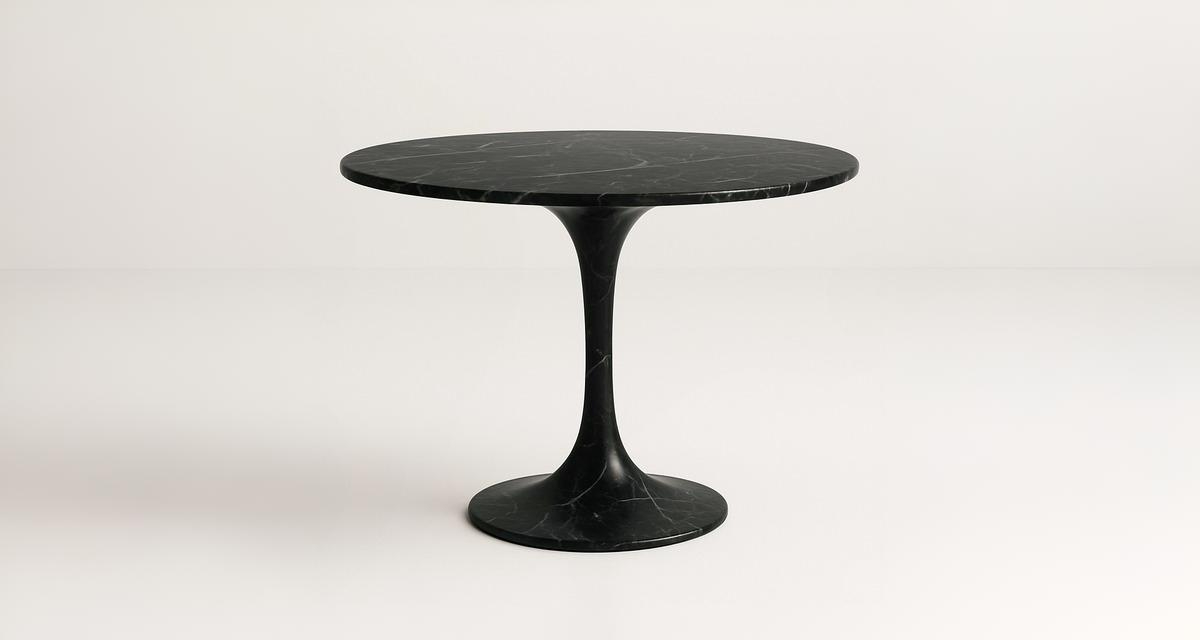
Tulip Table is not just a piece of furniture, it’s a timeless design statement in form, function, and philosophy. Designed by Eero Saarinen in the 1950s, this table emerged from a powerful desire to resolve the “ugly, confusing, unrestful world” beneath chairs and tables. What Saarinen achieved was far more than a cleaner silhouette, he reimagined how we gather, dine, work, and share space.
Today, the Tulip Table continues to feel as fresh and visionary as the day it was conceived. It’s been in continuous production for over 70 years and remains a centerpiece in contemporary interiors around the world. But why has this seemingly simple table remained so influential for so long?
Let’s dive into the origin story, the design concept, its historical significance, and why the Tulip Table will continue to shape interiors for generations to come.
The Birth of the Tulip Table: A Vision by Eero Saarinen
To understand the Tulip Table, we must begin with the brilliant mind behind it: Eero Saarinen. A Finnish-American architect and designer, Saarinen was a master of both structural drama and sculptural minimalism. Trained at the Cranbrook Academy of Art and later at Yale, he was deeply influenced by his father, Eliel Saarinen, a renowned architect in his own right.
Eero wasn’t interested in producing furniture for furniture’s sake. He was engaged in a larger mission: to resolve what he called the “slum of legs” found under tables and chairs. Dining sets, in his view, were cluttered by multiple legs, creating visual noise and limiting movement.
In 1956, while working with Knoll, the American furniture company famous for embracing bold modernist design, Saarinen unveiled his Pedestal Collection. This included side tables, coffee tables, dining tables, and matching chairs, all supported by a single, central column.
Launched in 1957, the Tulip Table broke the rules of traditional design. It featured a single, central pedestal base that flowed from a wide, round or oval top into a seamless aluminum stem, powder-coated in white or black. It was unlike anything before it, both in appearance and structural ingenuity.
At the heart of this collection was the now-iconic Tulip Table. Its design was deceptively simple: a round or oval top (usually in marble, laminate, or wood veneer) balanced delicately on a single tapering base made of cast aluminum. The effect was like a flower blooming from the floor, hence the name.
Know more about Eero Saarinen in the documentary:
The Concept Behind the Design: Unity and Flow
The Tulip Table was conceived with a radical idea to bring unity and visual clarity to the dining environment. Saarinen wanted to simplify the chaos beneath tables. His solution? One base instead of four legs. This not only offered a clean aesthetic but also improved functionality, allowing chairs to move freely around the table without bumping into legs.
His goal, he said, was to design a table that looked like it grew organically from the floor. He was inspired by nature, and it shows. The table’s form feels natural, flowing, and harmonious with the space around it.
But this was not just about aesthetics. Saarinen’s vision aligned with the mid-century modern philosophy of unity between form and function. Every curve, every angle served a purpose.
Time-Tested Quality: Why the Tulip Table Endures
The Tulip Table enduring appeal lies in the following key factors:
1. Universal Aesthetic Compatibility
Whether it’s placed in a mid-century modern home, a Scandinavian loft, or a contemporary office, it feels right. Its neutral elegance allows it to pair well with almost any chair style, from Saarinen’s own Tulip Chairs to Eames molded plastic chairs, or even rustic wooden ones. The table is a master of adaptation.
2. Functional Simplicity
There’s nothing extraneous in the Tulip Table. The central pedestal means more legroom, better movement, and less visual clutter. Its shape encourages conversation, making it ideal for dining rooms, meeting spaces, or creative work areas.
3. Material Integrity
Saarinen didn’t just design for looks, he designed for longevity. The table’s base, crafted from aluminum, resists corrosion. Its top, whether Arabescato marble, laminate, or wood, is made to endure generations of use. It’s common to find vintage models in perfect condition, even after decades.
The Tulip Table in Cultural Memory
The Tulip Table quickly found its way into the cultural zeitgeist. It was featured in films, design exhibitions, and elite interiors. But it never screamed for attention. It didn’t need to.
Its strength was always in its subtlety. In fact, one of its most powerful design features is its ability to make a statement without dominating the space. It draws the eye gently, the way a sculpture might draw you into contemplation without demanding it.
When design historians speak of iconic 20th-century furniture, the Tulip Table often appears in the same breath as the Barcelona Chair or the Eames Lounge. But unlike some other classics, which are often kept in display-like reverence, the Tulip Table is meant to be used.
Families have gathered around it. Artists have sketched on it. Designers have worked late into the night over it. It is not only beautiful, it is intimately human.

A Design That Adapts to the Future
The Tulip Table’s timelessness stems from both its design philosophy and its execution. As tastes change and interiors evolve, the table doesn’t become outdated. It transcends trends because it was never chasing them.
Let’s take a closer look at why this design continues to be future-proof:
1. Minimal Footprint in Small Spaces
With more people living in urban areas where space is at a premium, the single pedestal base becomes even more relevant. It provides ample legroom and helps maintain a sense of openness in tight quarters.
2. Pairs Beautifully with Modern Seating
Though it was originally paired with the Tulip Chair, this table complements a wide array of seating, from vintage Thonet bentwoods to contemporary molded plastic chairs. Its form is quiet enough to let other elements shine, but strong enough to hold its own.
3. Fits Across Styles
Whether you are curating a Japandi interior, a brutalist loft, or a cottage-core kitchen, the Tulip Table can be a chameleon. Its form doesn’t anchor it to a particular era or movement.
4. Sustainable Longevity
We are in a time when sustainability is no longer optional. The Tulip Table’s quality construction means it doesn’t get discarded. It’s passed down, resold, or refurbished. In a throwaway culture, this table stands for lasting value.
5. Visual Calm in a Chaotic World
As lives become more cluttered, digitally and physically, people crave spaces that promote calm. The Tulip Table provides that. Its smooth, uninterrupted lines bring a sense of order and peace.
6. Evolving Interpretations
Designers continue to reinterpret the Tulip Table for new generations. New finishes, materials, and pairings keep the design alive, while staying true to Saarinen’s original vision. From earthy walnut to high-gloss black, each version offers something fresh.
Iconic Models of the Tulip Table
While there are several iterations of the Tulip Table, a few models have stood out over time:
Round White Marble Tulip Table
Perhaps the most recognizable version, the round white marble Tulip Table combines luxurious natural stone with a lightweight aesthetic. It’s frequently seen in editorial shoots and high-end interiors.
Oval Tulip Dining Table
Designed to accommodate more guests, this model retains all the elegance of the original but with a more elongated form. It’s ideal for rectangular dining rooms and can double as a conference table in creative offices.
Compact Laminate Tulip Table
Perfect for urban living and studio apartments, the compact version maintains the original proportions but is more space-efficient.
The Legacy of a Design Revolution
Eero Saarinen passed away in 1961 at the age of 51, but his influence lives on. Today, the Original Tulip Table is produced under the Knoll license, ensuring that each piece is crafted to Saarinen’s original specifications, while there is other quality and evolution designs inspired truly by the original concept.
A Tulip Table is not merely a purchase, it is an investment in culture, in form, and in the pursuit of purity. It continues to appear in art galleries, films, celebrity homes, and design schools. Not because it’s vintage, but because it remains current.
Final Word: Why the Tulip Table Will Always Be Relevant
The Tulip Table doesn’t chase relevance. It is rooted in clarity, lifted by innovation, and fueled by beauty. It serves as a reminder that great design isn’t about flash or novelty. It’s about solving problems elegantly and creating objects that people live with, not just look at.
As we move further into a future of AI, virtual spaces, and adaptive homes, the Tulip Table will still matter. Not because it’s retro. But because it’s universal.
In a world hungry for authenticity and clarity, Saarinen’s creation continues to offer both.
So next time you walk into a room and see a Tulip Table, take a moment to appreciate what it really is: a flower of innovation, blooming endlessly, unfazed by the passing of time.