

A pepper grinder is among the most familiar objects in the kitchen. Its operation is almost prehistoric in its simplicity: hold, twist, crush. Yet the apparent simplicity of the gesture conceals a considerable design problem. The object must translate human movement into mechanical action while remaining comfortable, stable, durable, legible, and visually appropriate to its surroundings. The Alessi KG01 Grinder, designed by Konstantin Grcic, approaches that problem with unusual formal discipline. Rather than disguising its industrial character, the object makes manufacturing, geometry, and material part of its visual language.
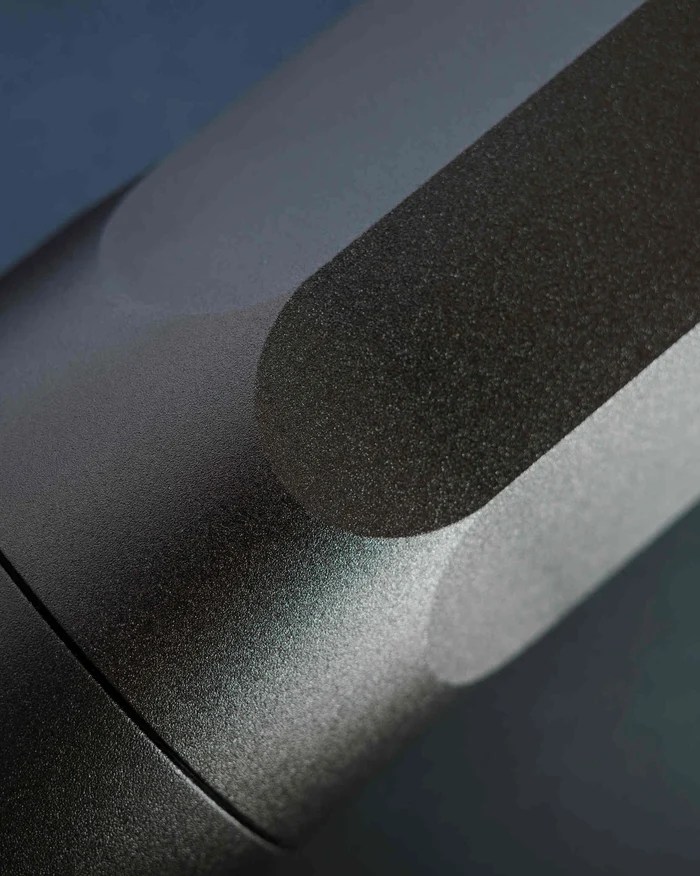
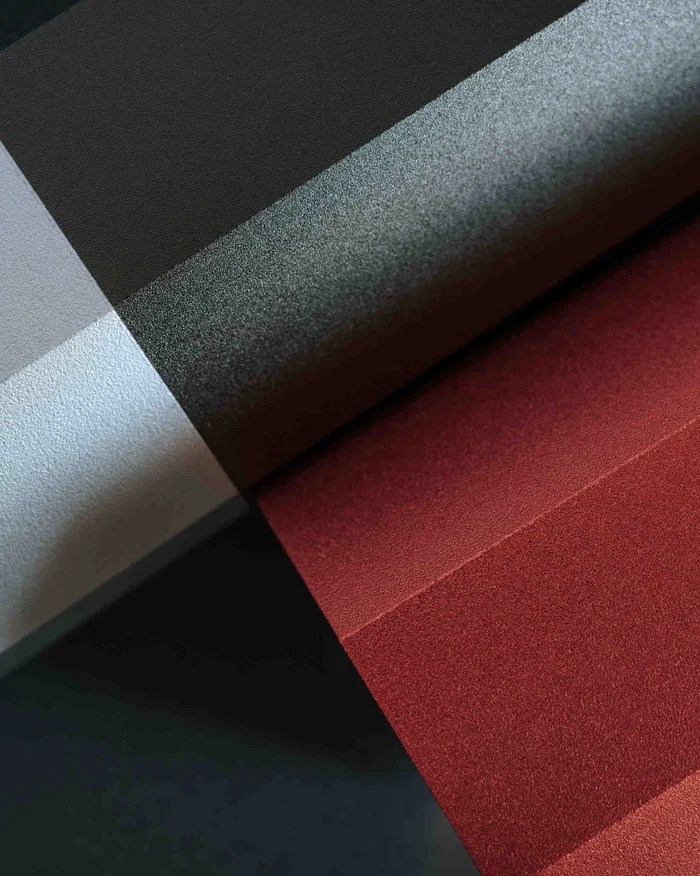
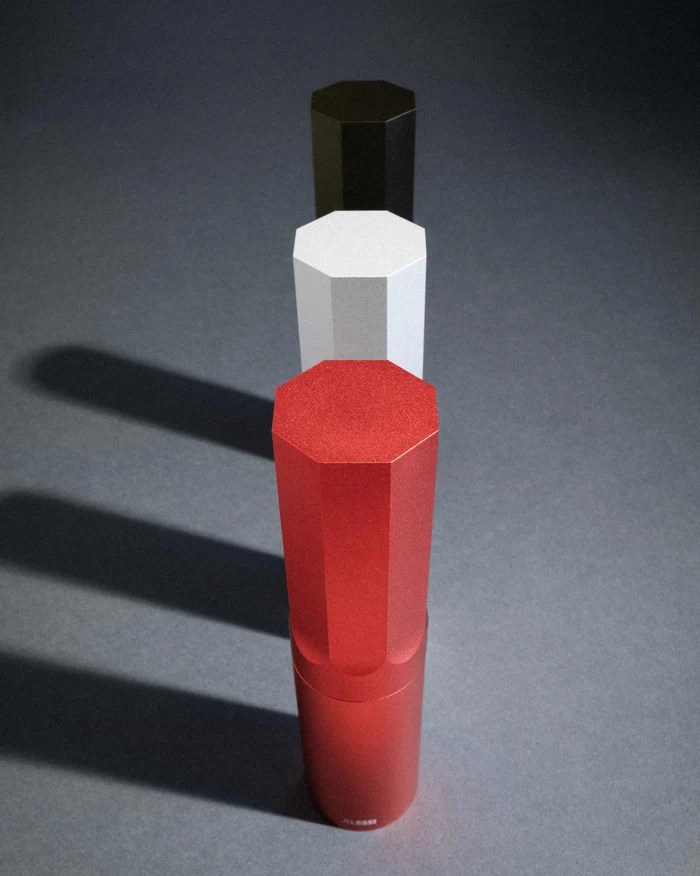
Alessi describes the KG01 as a salt, pepper, and spice grinder machined from a high-precision aluminium block, with a cylindrical body that transitions into an octagonal profile to guide the twisting motion. Its sandblasted surface adds another dimension: the object communicates through touch as much as through sight.
Standing approximately 8.55 inches high (21.7 cm) and 1.93 inches in diameter (4.9 cm), the KG01 has the vertical presence of a small architectural element rather than an anonymous utensil.
That distinction matters. The grinder belongs to a category of objects whose purpose is entirely ordinary, yet whose physical presence can influence the rituals surrounding that purpose. KG01 turns seasoning into a designed interaction.
Its significance therefore lies less in novelty than in precision. Grcic has taken an object whose basic mechanism has changed little and asked how its form, material and gesture can be reconsidered for contemporary life.
Alessi KG01 Grinder Design Concept: Geometry as an Instruction
The strongest quality of KG01 is that its geometry does practical work.
At first glance, the grinder appears almost severe: a tall, compact volume with a cylindrical body and a more faceted upper section. Yet the transition is carefully calculated. According to Alessi, the movement from the cylinder to the octagonal profile intuitively guides the twisting action. The geometry therefore functions as a kind of physical interface. There is no need for an arrow, button, graphic instruction, or explanatory symbol. The hand understands the object through its shape.
That principle is central to good industrial design: form can communicate operation.
Grcic’s approach is particularly interesting because the form does not attempt to conceal its construction. The aluminium body suggests machining rather than moulding, and the sandblasted finish reinforces the sense of an object shaped through industrial processes. Instead of treating manufacturing as something to hide behind decoration, KG01 makes production part of its identity.
The designer’s background helps explain this attitude. Grcic trained as a cabinetmaker before studying industrial design at the Royal College of Art in London. Since establishing his practice in 1991, he has worked across furniture, products, lighting, exhibitions, architecture, and fashion. His studio describes his work as combining historical research, technological interest, formal precision, and an understanding of function in human terms.
KG01 follows that methodology closely.
Its intelligence is not concentrated in one spectacular gesture. Instead, it emerges from the relationship between hand, material, mechanism, proportion, and manufacturing.
The History Behind the Object
The pepper grinder has a surprisingly rich industrial history. Although the act of crushing spices is ancient, the modern domestic grinder developed through a succession of mechanical refinements that transformed a repetitive culinary action into a compact household device.
That lineage makes KG01 particularly revealing. It belongs to a long tradition in which designers improve everyday objects not by changing what they fundamentally do, but by reconsidering how people interact with them.
Alessi provides another important historical layer. Founded in 1921 by Giovanni Alessi and his brother in Omegna, the company began as a workshop working with brass, nickel silver, and other metals. Its early reputation was rooted in craftsmanship and meticulous finishing. During the 1950s, Alessi moved progressively from an artisanal production model toward industrial manufacturing, with stainless steel becoming increasingly important.
By the 1970s, collaborations with designers such as Ettore Sottsass, Richard Sapper, Achille Castiglioni, and Alessandro Mendini helped transform Alessi into something more culturally ambitious: a company where industrial production and design experimentation could coexist. Later projects expanded that approach through collaborations with architects and designers from around the world.
KG01 consequently belongs to a distinctly Alessi tradition. The company has repeatedly used familiar domestic objects as vehicles for design research.
What changes here is the vocabulary. Earlier Alessi objects often explored expressive curves, colour, symbolism, or architectural references. Grcic instead brings a language of precision, mass, geometry, and industrial tactility.
The result demonstrates that Alessi’s design culture can accommodate restraint without abandoning character.
Aluminium, Mass and the Tactile Logic of the Alessi KG01 Grinder
The grinder is made from machined aluminium, and that decision gives the object a particular physical authority. Aluminium can be precise, lightweight, recyclable, industrially familiar, and visually neutral. More importantly, machining allows the designer to articulate geometry with considerable accuracy.
The distinction between machined and moulded objects becomes perceptible here. The KG01 looks as though it has been cut from a solid volume, giving its surfaces a sense of intentionality. The object does not merely occupy space; it appears to have been defined through subtraction and controlled transformation.
The sandblasted finish changes the experience again. A polished metal surface would emphasise reflection and visual sharpness. Instead, the textured treatment produces a quieter surface that invites the hand. Alessi explicitly describes the finish as creating an unexpected tactile pleasure.
That relationship between visual austerity and tactile richness is one of the most sophisticated aspects of the design.
The grinder may look technical, but it does not behave like laboratory equipment. The surface gives it warmth through touch. The octagonal transition creates grip. The vertical proportion gives the hand enough territory to establish a controlled rotation.
The design is therefore experienced sequentially: first seen, then held, then operated.
This is important because kitchen objects are rarely encountered as static sculptures. They live through repetition. Their quality emerges during the hundredth use, not merely the first glance. KG01 understands that distinction.
Why the Alessi KG01 Grinder Can Become a Time-Proof Design
A time-proof object needs more than visual longevity. It needs a reason to remain useful.
KG01 has several characteristics that support that possibility.
First is functional clarity. The object performs an established task without introducing unnecessary complexity. There is no dependence on a changing digital ecosystem, software, batteries, or interfaces. Its fundamental relationship with the user is mechanical and immediate.
Second is material legibility. Aluminium remains recognisable as aluminium. The design does not rely heavily on fashionable surface effects or decorative motifs that could quickly date it.
Third is formal economy. The basic vocabulary consists of a cylinder, an octagonal transition, controlled proportions, and a restrained surface treatment. Such a vocabulary can remain relevant because it derives from geometry and ergonomics rather than from a transient stylistic trend.
Fourth is repairability and longevity as design questions. The real test of any grinder will ultimately involve the durability of its internal mechanism, the availability of replacement components, and how the material ages through repeated use. Those aspects cannot yet be judged historically because Alessi KG01 production started recently.
Time-proof design should not mean declaring an object timeless at launch. It means creating conditions in which longevity is possible.
KG01 possesses those conditions through clarity, material honesty, ergonomic logic, and resistance to unnecessary visual fashion.
Present-Day Relevance: The Kitchen as a Design Laboratory
Contemporary kitchens have become increasingly sophisticated environments. They are simultaneously workplaces, social spaces, places of display, and increasingly important expressions of personal taste. Within that context, small utensils acquire unexpected significance.
The KG01 occupies very little physical space, yet it participates in the visual culture of the kitchen. Its vertical form allows it to stand visibly rather than disappear into a drawer. It can therefore be understood as part of the transition from the kitchen utensil as hidden equipment to the utensil as domestic design object.
That shift has a long relationship with Alessi. The company’s catalogue has historically treated ordinary domestic products as opportunities for creative interpretation, bringing together industrial production and collaborations with designers, architects, and artists. Alessi now describes its catalogue as comprising more than 1,400 creations developed with over 900 creative collaborators.
KG01 fits that cultural model while representing a particularly contemporary sensibility.
Its appeal also lies in the current interest in material authenticity and tactile interaction. At a time when many products are mediated by screens, sensors, and automated systems, a mechanical object operated directly by the hand has a particular relevance. Twisting a grinder is almost deliberately analogue.
The user supplies the energy. The object transforms it. The mechanism performs its task. The result is immediately understood. That simplicity has cultural value.
Konstantin Grcic and the Discipline of the Everyday
KG01 also makes sense within the wider trajectory of Grcic’s work.
His portfolio includes objects that frequently examine the relationship between industrial technology and human behaviour. The MYTO chair, for example, emerged from collaboration with BASF and used an advanced injection-moulded plastic to create a structurally expressive form. MoMA includes the chair in its collection and describes its distinctive geometry in relation to the properties of the material.
The connection with KG01 is not stylistic. It is methodological.
In both cases, material technology becomes an active part of the design argument. Grcic does not simply select a material after establishing a form. The characteristics of production, structure, proportion, and use participate in determining the object.
His training as a cabinetmaker is also significant. Cabinetmaking begins with material, tools, joints, tolerances, and the behaviour of the hand. Industrial design expands those concerns to mass production, but the fundamental question remains familiar:
How should an object be made so that it feels inevitable when used?
KG01 seems to approach that question through a contemporary industrial vocabulary.
The grinder consequently belongs to a broader body of work in which precision does not eliminate personality. Instead, personality emerges from how precisely the object understands its purpose.
Alessi KG01 Grinder Future Outlook: Designing for Use Beyond the Present
If the KG01 mechanism proves durable, if its materials age gracefully, and if the object can remain serviceable through years of use, its design has the potential to acquire something that cannot be designed entirely in advance: patina through experience.
That possibility is particularly compelling with aluminium. Unlike disposable plastic objects, a substantial metal object can accumulate traces of handling and time. Scratches, changes in surface character, and small signs of use can become part of its biography rather than evidence that the object has failed aesthetically.
There is also a broader lesson here for contemporary product design.
The future does not necessarily require objects to become more technologically complicated. In many cases, the more valuable innovation may involve making familiar interactions more precise, more durable, and more intelligible.
The grinder remains a grinder. Salt remains salt. Pepper remains pepper. The hand still performs the same fundamental movement.
Yet the object surrounding that movement has been reconsidered through industrial geometry, machining, ergonomics, and tactile experience.
That is where its potential time-proof quality resides.
Good product design does not need to predict the future. It needs to remain meaningful when the future arrives.
The Alessi KG01 Grinder begins from an extraordinarily modest premise and gives it architectural clarity. In the hands of Konstantin Grcic, the humble pepper grinder becomes a compact study in material and human movement, demonstrating how much design intelligence can reside inside an object whose entire purpose is to be held, twisted, and used.
For a product introduced in 2026, its historical significance cannot yet be measured by longevity. But its design principles are already clear: functional clarity, material expression, tactile intelligence, and formal discipline.
Those are precisely the qualities that give an everyday object the possibility of lasting beyond the moment in which it was designed.