
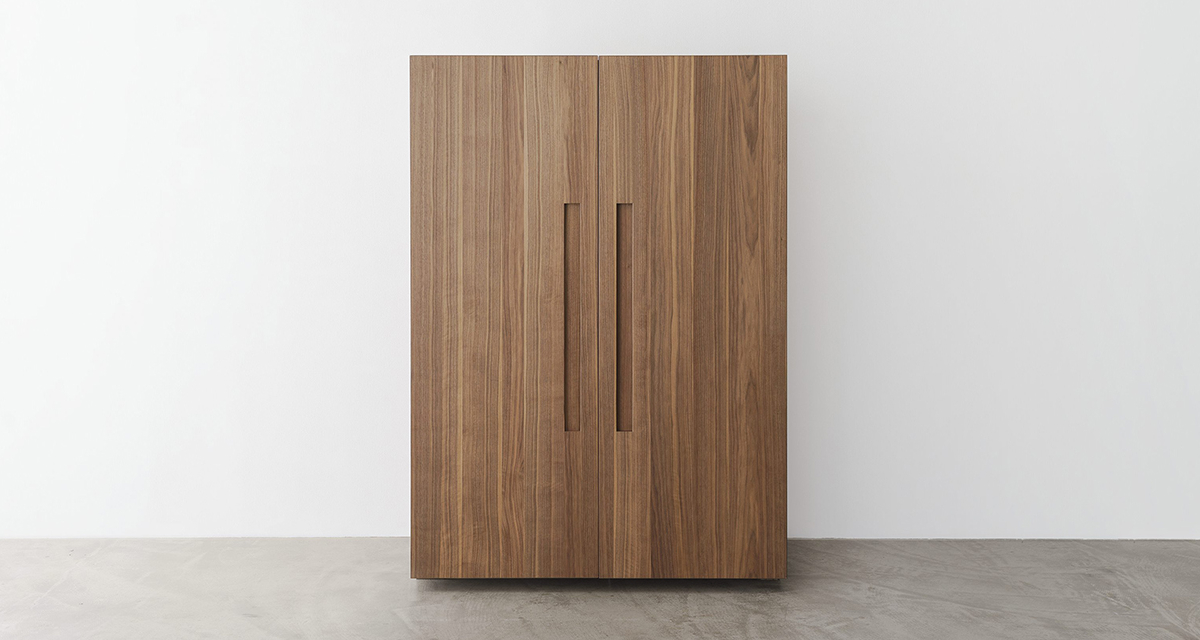
The Bulthaup System B developed through the collaboration between entrepreneur Gerd Bulthaup and designer Otl Aicher in the early 1980s, it emerged from a sustained investigation into cooking as a sequence of physical, social, and sensory activities.
A conventional kitchen is typically organized as a perimeter of fixed elements of cabinets, appliances, and storage units, arranged around a room. Aicher approached the problem differently. He examined how the body moves, how tools are handled, how ingredients circulate, where communication occurs, and how work can coexist with domestic life. The kitchen consequently became a field of human activity that could be observed, analyzed, and reorganized.
Aicher’s intellectual formation at the Hochschule für Gestaltung Ulm provided an important foundation. Ulm had rejected design understood primarily as stylistic expression, advocating instead for analytical methods, functional clarity, and a rigorous relationship between form and use. Yet Aicher’s kitchen thinking was never purely technical. His research connected ergonomics with culture, and physical efficiency with the social meaning of cooking.
His 1982 book Die Küche zum Kochen, translated as The Kitchen for Cooking, crystallized this position. Aicher’s subject was not the kitchen as a decorative domestic image, but the kitchen as a place in which people work, cook, eat, communicate, and organize everyday life.
Bulthaup System B can therefore be read as a material argument about domestic space. It proposes that design should begin with activity, that furniture can structure behavior without dictating it, and that the kitchen can function simultaneously as workshop, meeting place, and architectural system.
Bulthaup System B Design Concept and Philosophy
The conceptual shift behind System B begins with a simple reversal of priorities.
Instead of treating the kitchen as a perimeter to be filled, Aicher and Bulthaup considered the person working within it as the primary reference point. Bulthaup’s account of the period places ergonomics at the center of the design process, with the organization of the kitchen subordinated to the needs of the user.
This is significant because ergonomics here is broader than dimensional comfort. It concerns the sequence of actions.
A cook does not experience a kitchen as a catalogue of components. The experience unfolds through movement. A hand reaches for a knife. An ingredient moves from storage to preparation. Waste is removed. Water is introduced. Heat is applied. Food returns to a surface. Another person enters the space and communication begins.
Bulthaup System B addresses these transitions as an interconnected system.
The resulting design philosophy has several distinct characteristics. Functions are differentiated, but relationships remain continuous. Storage, preparation, cooking, washing, and social interaction are considered together. The objective is not to maximize the number of functions, but to make their relationships more coherent.
Aicher’s approach also challenged the assumption that efficiency must produce an impersonal environment. The kitchen could be rational without becoming clinical. A well-organized workspace could also become a social space.
This is one reason the work remains theoretically interesting. System B demonstrates that human-centered design does not require the suppression of form. Rather, form can emerge from the study of behavior.
The system therefore occupies a productive space between industrial design and architecture. Each component has a practical role, yet the larger composition establishes a spatial order. The result is a design system in which furniture begins to behave architecturally.
Bulthaup System B Historical Context and Heritage
System B becomes easier to understand when placed within the longer history of rational kitchen design.
One important predecessor was the Frankfurt Kitchen, developed by Margarete Schütte-Lihotzky in the 1920s. It introduced a highly organized domestic workspace based on efficiency, hygiene, compact storage, and the reduction of unnecessary movement. The project became a landmark because it treated the kitchen as a space that could be systematically analyzed.
Later, the Bauhaus and the Ulm School extended this modernist interest in function, production, materials, and human behavior. Yet the relationship between these movements and Bulthaup System B is not simply one of linear inheritance. Aicher revisited rationalization from a different cultural position.
The problem was no longer only how to make domestic labor faster. It was also how to reconcile work, communication, and contemporary patterns of living.
Otl Aicher and Gerd Bulthaup began their collaboration around 1980. Bulthaup’s history identifies this period as a turning point in the company’s development, influenced by functionalist thinking and the Bauhaus principle traditionally summarized as “form follows function.”
System B followed as an important expression of that new direction, with the system formally presented in 1984.
Its emergence also coincided with a broader cultural transformation in the domestic interior. The kitchen increasingly moved from the hidden service zone toward the center of household life. The social distinction between cooking and living began to weaken.
Aicher recognized this shift not as a passing lifestyle trend, but as a change in spatial logic.
Aicher’s Kitchen as Design Research
Aicher’s contribution is especially important because he did not approach the kitchen solely through formal composition. He investigated kitchens comparatively, examining different cultures and culinary practices. Bulthaup records research involving more than 50 journeys through different culinary environments.
The significance of this research lies in methodology.
Rather than assume that a universal kitchen could be designed from a fixed set of conventions, Aicher looked for recurring patterns beneath cultural variation. Cooking differs from one place to another, yet fundamental actions recur: handling, cutting, heating, storing, washing, serving, and gathering.
This approach reflects a central principle of modern design research: look for structural behavior beneath visible differences.
The same logic informed Aicher’s broader professional work. He repeatedly sought order within complex systems, whether through visual communication, information graphics, corporate identity, or the organization of physical environments.
The kitchen presented an unusual challenge because it combined measurable operations with deeply personal behavior.
One cannot design cooking entirely through equations. Smell, memory, habit, hospitality, improvisation, and conversation all influence the experience. Bulthaup System B therefore operates between rational organization and human variability.
That balance is one of its most sophisticated qualities.
Its logic provides a framework, but the framework does not require one predetermined way of living. The kitchen can be used by a solitary cook, a family, or several people working together. Its organization supports activity without reducing domestic life to a flowchart.
This is where ergonomics becomes culture.
The Workbench and the Reversal of the Traditional Kitchen
The central work surface became a critical element in Aicher’s thinking.
At Aicher’s home in Rotis, the rural kitchen was organized around a central table. The table became an important prototype for the idea that preparation should occupy the center of domestic space rather than disappear against a wall. The Otl Aicher archive describes this principle as part of his development of the kitchen as a place of cooking and communication.
This spatial reversal has substantial consequences.
When a work surface sits at the center, access becomes multidirectional. Movement becomes more legible. Multiple people can participate. The cook can remain connected with the surrounding room rather than turning permanently toward a wall.
The idea seems familiar today because contemporary kitchen islands have made central workspaces commonplace. Yet familiarity can obscure how radical the shift was.
Aicher’s central table was not merely an island before islands became fashionable. It represented a different model of domestic organization. The kitchen was no longer a room whose edges were occupied by infrastructure. Infrastructure could become an independent spatial element around which life organized itself.
Bulthaup’s later Kitchen Workbench, introduced in 1988, developed this concept further. The workbench concentrated essential kitchen functions around a freestanding unit and emphasized the relationship between fire and water. Bulthaup considers it a significant ergonomic innovation in the company’s history.
The trajectory demonstrates how System B opened a larger field of research: once the kitchen was understood as a system of activities, its components could be detached from the architectural perimeter and reorganized according to use.
Why the Bulthaup System B Is a Time-Proof Design
The durability of System B is easier to explain through principles than through appearance.
A design becomes time-proof when its core logic remains meaningful even as its technological, cultural, and visual surroundings change. System B has that quality because it was built around human actions rather than around a temporary image of modernity.
People still prepare food. They still need surfaces, storage, water, heat, tools, and circulation. New technologies modify the means, but they do not eliminate the underlying sequence.
That gives the system a form of functional permanence.
Its visual resilience follows the same logic. Bulthaup System B does not depend heavily on decorative motifs associated with a particular period. Material, proportion, structure, and organization provide its character. Such qualities tend to age more slowly because they are connected to construction and use.
There is also conceptual adaptability. Bulthaup’s later development demonstrates a sustained interest in modularity and spatial flexibility. System 25, introduced in the 1990s, expanded the possibilities for individual configuration, while later systems explored increasingly architectural approaches to kitchens and living spaces.
This suggests a more precise definition of time-proof design.
A lasting design does not have to remain physically identical. It must preserve its relevance while allowing its expression to evolve.
Bulthaup System B achieves this because its deeper principles are relatively independent from one specific arrangement of modules.
The distinction is crucial. A style can become dated. A design methodology can continue generating useful solutions.
Material Honesty as a Form of Longevity
Material choice in System B should also be understood through Aicher’s broader design philosophy.
Aicher argued for authenticity in material and function, rejecting unnecessary visual effects in favor of a clear relationship between what something is and what it does. Bulthaup’s account of the 1982 collaboration explicitly identifies material authenticity as part of the philosophy behind the work. This principle has implications beyond aesthetics.
When a material performs a clear task and communicates that role honestly, the object becomes easier to understand. Surfaces appear as work surfaces. Storage behaves as storage. Structural divisions make spatial relationships legible.
The design consequently acquires a kind of semantic stability. It does not require constant reinterpretation because its meaning is embedded in use.
This connects System B to a wider tradition that includes the work of designers such as Hans Gugelot, Dieter Rams, and other figures associated with European functionalist and systems-oriented design. The common principle is not a single visual style. It is an insistence that design should establish a coherent relationship among purpose, construction, perception, and behavior.
In domestic design, this matters greatly because the surrounding environment changes continuously. Furniture is combined with architecture, personal possessions, appliances, artwork, and years of accumulated experience.
A highly expressive kitchen can dominate that environment. A disciplined system can instead provide a framework for living. That distinction contributes directly to longevity.
Present-Day Relevance: The Kitchen as Social Infrastructure
Contemporary domestic architecture has moved closer to many of Aicher’s propositions.
Open-plan interiors have weakened the historical separation between kitchen, dining room, and living room. The kitchen island now frequently functions as a workspace, gathering point, food-preparation surface, informal desk, and social boundary.
The change confirms that Aicher was dealing with a structural transformation rather than a temporary aesthetic tendency.
The Otl Aicher archive describes his ambition to overcome the separation between kitchen and living space, making cooking part of domestic communication rather than isolating it from everyday life.
System B remains relevant because it addresses precisely this condition.
Its deeper contribution is not a particular cabinet profile. It is the proposition that domestic space should be organized around relationships among activities.
That idea has become increasingly valuable as homes take on more simultaneous functions. Kitchens are now expected to accommodate remote work, informal meetings, social gatherings, solitary routines, family life, and increasingly sophisticated food preparation.
The contemporary challenge is therefore not simply to fit more equipment into less space. It is to create environments that can accommodate multiple modes of occupation without losing coherence.
System thinking offers an answer. Instead of treating flexibility as an afterthought, the design can make adaptability part of its underlying structure. This is particularly relevant to sustainability. Long life depends not only on physical durability but also on continued usefulness. A kitchen that can accommodate changing households and new technologies has a better chance of remaining relevant than one optimized for a single moment.
Bulthaup System B Future Outlook
The future kitchen will almost certainly contain technologies that Aicher could not have predicted. Artificial intelligence may influence food planning. Appliances may become increasingly automated. Sensors, connectivity, robotics, and new materials will alter how tasks are performed.
Yet these developments create a stronger case for the principles behind System B rather than making them obsolete.
Technology changes the means of action. It does not eliminate the need to understand human behavior within space.
The central question for future kitchen design will therefore remain remarkably close to Aicher’s: how should space, tools, information, and the body relate? This is where the enduring significance of System B becomes clearest.
A design that attempts to predict the future often becomes trapped by its predictions. A design that establishes durable relationships can accommodate futures it never anticipated. System B belongs to the second category.
Its intellectual legacy lies in the decision to design the kitchen as a system of actions rather than as a finished image. That decision permits technological change without requiring a complete conceptual reset.
It also offers a broader lesson for contemporary industrial design.
Time-proof design is rarely produced by eliminating change. It is produced by identifying what should remain stable while allowing everything else to evolve.
For Bulthaup System B, the stable elements are human scale, purposeful organization, material clarity, ergonomic logic, and the social value of cooking. The adaptable elements are technologies, configurations, finishes, and domestic patterns. That distinction explains why the system continues to matter.
Otl Aicher did not design a kitchen for one historical moment. He established a method for thinking about kitchens. And methods, when they are rooted in durable observations about human life, can remain useful long after their original objects have entered design history.