
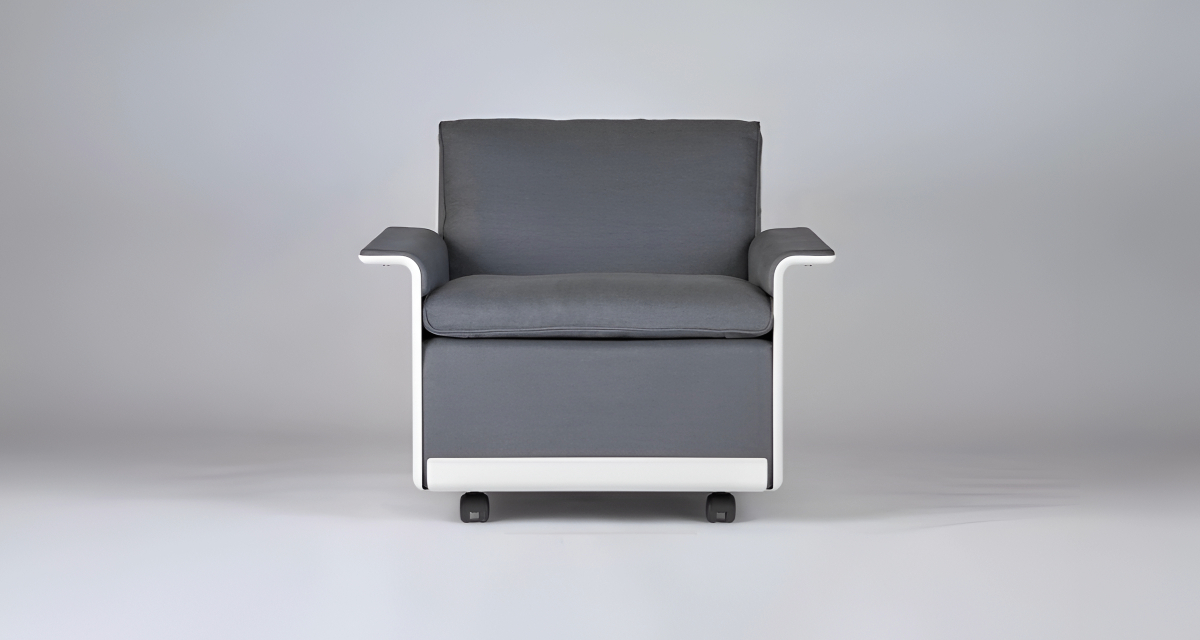
The Vitsoe 620 Chair Programme, developed by Dieter Rams in 1962, was designed around the possibility of change.
At first glance, the 620 appears almost restrained to the point of anonymity. Its upholstered cushions sit within a compact structural frame, creating a visual clarity that makes the chair easy to understand. Yet beneath that apparent simplicity lies a more ambitious proposition. Rams was designing a piece of furniture that could be reconfigured, extended, repaired, and adapted as the user’s circumstances evolved.
This distinction matters. The 620 was conceived during a period when industrial design was increasingly concerned with mass production, functional efficiency, and the modern home. Rams pushed those concerns further. Instead of treating furniture as a finished product, he approached it as a long-term system.
A single seat could operate independently. Additional elements could be connected to create a larger arrangement. Components could be replaced rather than forcing the entire object into obsolescence. The chair therefore occupied an unusual territory between product and architecture.
Its significance in design history comes from this idea of planned adaptability. The Vitsoe 620 Chair system anticipated a contemporary concern that is now central to sustainable product design: how can an object remain useful when the life around it changes?
More than six decades later, that question remains remarkably current.
Vitsoe 620 Chair Design Concept: Furniture as a System
The central innovation of the Vitsoe 620 lies in its structure. Dieter Rams designed the chair as a modular system, giving users the ability to connect individual units and create different seating configurations.
The concept sounds straightforward, but its implications are considerable.
Traditional upholstered furniture tends to define its own limits. A sofa has a predetermined length. A lounge chair has a fixed role. Once purchased, the object largely dictates how it will occupy a room. The Vitsoe 620 Chair reverses that relationship. Its components allow the user to determine the configuration. That makes the chair a form of spatial design as much as seating.
A single module can work as an armchair. Several elements can form a sofa. Corner and connecting components allow the arrangement to expand or change direction. This capacity for recombination gives the system a quality uncommon in furniture of its period.
Rams also understood that modularity only works when the individual elements remain visually coherent. The 620 therefore avoids the awkward appearance that can emerge when expandable furniture accumulates visible mechanisms and compromises.
The construction is deliberately legible. The frame establishes a clear geometric order, while the cushions soften that structure without concealing it.
Here, Rams’s characteristic approach becomes evident: function, construction, and appearance should support one another.
The user’s experience is similarly important. Changing the chair does not require abandoning it. The object can respond to a new apartment, a growing family, a different room, or a new way of living. That makes the act of ownership less static. The user participates in the life of the design.
Dieter Rams and the Discipline of Less
The Vitsoe 620 Chair Programme is inseparable from Dieter Rams’s broader design philosophy. Rams became one of the most influential figures in twentieth-century industrial design through his work at Braun, where he developed products characterized by clarity, restraint, and careful hierarchy.
His design thinking rejected decoration for its own sake. Yet it would be misleading to describe his work simply as minimalist.
Rams’s restraint was primarily structural and intellectual. Every visible element had a reason to exist. Materials, proportions, controls, surfaces, and interfaces were organized so that the object could communicate its purpose without unnecessary visual noise. The 620 carries this discipline into furniture.
Its geometry is clear without becoming theatrical. Upholstery provides comfort while maintaining a sense of order. The frame gives the system an architectural backbone. Nothing appears to be competing for attention. This was crucial to the chair’s longevity.
Designs tied heavily to a particular fashion often age quickly because their identity depends on contemporary visual codes. Rams pursued a different strategy. He sought clarity rather than novelty, allowing the object to remain legible even as tastes changed.
That principle becomes especially powerful in furniture because furniture exists within constantly changing interiors. A chair may move from a living room to a study, from a private home to a professional setting, or from one generation’s taste to another’s.
The Vitsoe 620 Chair was equipped for that movement from the beginning.
Historical Context: The Modern Home Becomes Flexible
To understand the importance of the Vitsoe 620 Chair Programme, it helps to look at the period in which it emerged.
Europe in the early 1960s was experiencing rapid social and economic transformation. Modern housing was becoming more widespread, domestic technology was changing everyday routines, and industrial production was reshaping consumer culture. Furniture responded to these shifts.
Earlier modernist furniture had already challenged traditional ideas of domestic space. Designers such as Marcel Breuer, Mies van der Rohe, Le Corbusier, and Alvar Aalto had explored new relationships between structure, material, ergonomics, and industrial production.
Rams inherited this modernist tradition but approached it with a distinctly postwar sensibility. The question was no longer simply how to create a modern-looking chair. It was how to design products suited to a world in which life itself was becoming increasingly fluid.
Its modular logic echoed developments in architecture and systems thinking. Instead of imagining the home as a static composition, it recognized that domestic environments could evolve. A room might need to perform several functions. A family might change. A residence might become smaller or larger. Furniture could therefore benefit from the same flexibility being explored in contemporary architecture.
The system also reflected a growing awareness of industrial production. Standardized elements could be manufactured efficiently, while the user could still achieve individualized arrangements.
That combination of standardization and personal choice became one of the defining promises of modern industrial design. The Vitsoe 620 Chair expressed it with unusual elegance.
Why the Vitsoe 620 Chair Is a Time-Proof Design
A time-proof object design must survive several different tests.
Must remain visually relevant, retain practical usefulness, and accommodate changing circumstances. Ideally, it should also resist becoming disposable. The Vitsoe 620 Chair Design System performs strongly across all four.
1. Adaptability Instead of Fixed Purpose
Its strongest advantage is the ability to change configuration.
The chair can expand, contract, and reorganize without losing its identity. This gives it an unusual relationship with time. Instead of becoming obsolete when the user’s needs change, the system can absorb those changes.
A product can have a long physical life and still become functionally obsolete. The 620 reduces that risk by separating the lifespan of the system from the specific configuration of the moment.
2. Components Can Have Independent Lives
Modularity also changes the logic of maintenance.
A damaged or worn component does not necessarily condemn the entire seating system. Individual elements can be replaced, while the remaining structure continues in use.
This approach anticipates today’s emphasis on repairability, longevity, and circular design. The most sustainable object is often the one that does not need to be replaced.
3. Visual Restraint
The chair’s appearance has another advantage: it does not depend on fashion.
Its geometry is based on proportion, repetition, and structural clarity. These principles remain understandable even when decorative preferences shift.
This is one reason Dieter Rams design continues to influence contemporary product designers. His work demonstrates that reduction can create longevity when it is grounded in logic rather than trend.
4. The System Becomes Part of Its Owner’s Life
Perhaps the most subtle quality of the Vitsoe 620 Chair is psychological.
People often discard objects not because they stop functioning, but because those objects no longer fit their lives. The 620 addresses this problem by allowing its users to participate in the design.
The chair can become larger when the household changes: Can be separated into individual seats, move to another room, and ages with the user rather than against the user. That is a powerful definition of enduring design.
Vitsoe 620 Chair Present-Day Relevance: Modularity Before It Became a Trend
The 620 feels surprisingly contemporary because many of today’s design concerns were already embedded within its original logic.
Contemporary designers increasingly explore modular furniture, adaptable interiors, repairable products, and product-service systems. These approaches respond to smaller urban homes, changing work patterns, resource pressures, and the environmental cost of constant replacement.
In a contemporary apartment, flexibility can be more valuable than sheer size. A modular seating system allows one object to support several spatial arrangements. In hybrid living environments, where domestic rooms may also serve as workplaces or social spaces, adaptability becomes a practical necessity.
The chair also fits the growing cultural interest in long-life design.
Consumers increasingly ask where products come from, how they are constructed, whether they can be repaired, and how long they are expected to last. The 620 provides a useful historical example because these questions are not treated as additions to the design. They are integrated into its fundamental logic.
Its continued association with Vitsoe is equally significant. The brand has maintained a philosophy centered on durable, modular products that can evolve rather than simply being replaced.
The therefore feels relevant not because it has been periodically redesigned to follow contemporary fashion, but because its original principles already anticipated many contemporary needs.
The Quiet Power of the Vitsoe 620 Chair Design System
There is another reason the chair deserves attention.
The history of industrial design often celebrates dramatic moments: radical forms, technological breakthroughs, spectacular materials, and objects that immediately announce their arrival. The Vitsoe 620 Chair belongs to another tradition.
Its achievement is quieter. It demonstrates how a designer can transform the everyday through relationships rather than gestures.
The relationship between one seat and another. Between furniture and architecture, needs and future, and the product and the person who owns it.
This is where Rams’s intellectual contribution becomes especially important.
He did not treat simplicity as an aesthetic effect. He treated it as a method for making objects understandable, useful, and durable.
The 620 therefore asks a deceptively difficult question: What should a chair become when we stop assuming that its final form must be decided on the day it is purchased?
Rams’s answer was to let the system remain open. That openness is the real innovation.
Future Outlook: Designing for an Unfinished Life
The future value of the Vitsoe 620 does not depend on nostalgia for 1960s modernism. Its relevance comes from a principle that is becoming increasingly important: products should be designed for change.
Housing is changing. Work is changing. Household structures are changing. Expectations around sustainability are changing. A rigid product can struggle to survive within such conditions.
A modular product has another advantage. It can remain stable while its configuration evolves. That creates a different model of product longevity. Instead of designing an object that attempts to remain permanently unchanged, the designer creates a framework capable of accommodating change.
The future may bring new upholstery technologies, new materials, new manufacturing methods, and new environmental expectations. Yet the underlying idea of the 620 remains strong: build the product as a durable system, then allow the system to adapt. This principle extends far beyond chairs.
It can inform shelving, lighting, storage, kitchens, workspaces, electronic products, and even entire buildings. In each case, longevity can come from the ability to modify rather than discard.
That is why the Vitsoe 620 remains such an instructive object in design history.Its greatest achievement was not creating a chair that could last for decades.
It was creating a chair that could change without losing itself.
A Definition of Time-Proof Design
The Vitsoe 620 Chair Programme occupies a distinctive position in modern furniture history because it treats longevity as a design problem rather than a prediction.
Dieter Rams created a system in which clarity, modularity, repairability, comfort, and adaptability work together. The result is furniture that can respond to changing spaces without surrendering its visual identity. Its enduring lesson is therefore larger than the chair itself.
Time-proof design does not require an object to remain frozen in time. It requires the object to remain useful as time changes. That is the deeper intelligence of the Vitsoe 620 Chair Programme.
Its design gives the user room to modify, expand, separate, repair, and reinterpret. The restrained visual language allows it to move between generations. Its modular construction gives it a practical resilience that many fashionable products lack.
More than sixty years after its introduction, the Vitsoe 620 still feels relevant because it addressed a problem that never disappeared: how to make things that can belong to a life for a long time.
In that sense, the Vitsoe 620 Chair offers one of the clearest expressions of Dieter Rams’s enduring design philosophy. The chair does not attempt to defeat time. It is designed to live with it.