
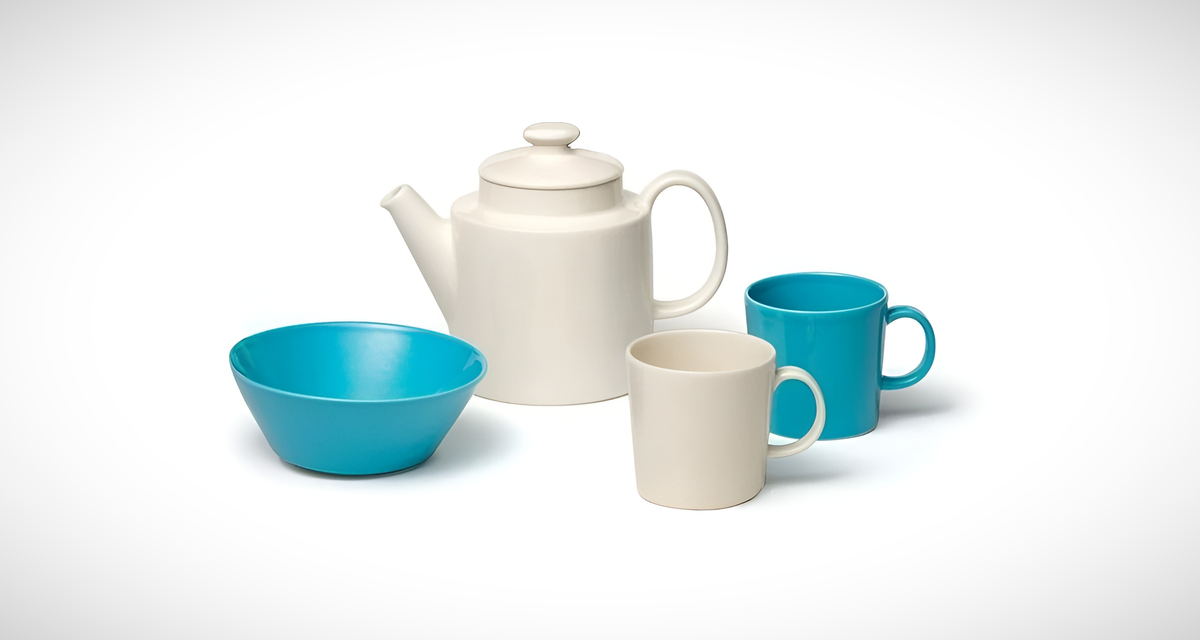
The Iittala Teema Tableware Collection occupies a singular position in the history of product and industrial design. Designed for everyday life yet shaped by rigorous intellectual thinking, Teema represents a quiet revolution in how tableware can function, feel, and endure. Rather than aiming for visual spectacle, the collection focuses on clarity, adaptability, and long term relevance. Its continued presence on dining tables across generations proves that meaningful design does not need constant reinvention.
Rooted in Finnish cultural values and guided by the disciplined vision of Kaj Franck, Teema has become a benchmark for time proof tableware design. The collection demonstrates how thoughtful reduction, ethical intent, and human-centered design can create objects that remain useful and desirable decade after decade.
Iittala Teema Tableware Finnish Design Heritage
To understand Teema, it is essential to consider the design culture from which it emerged. Iittala was founded in 1881 in Finland as a glassworks, later evolving into a leading force in Nordic design. Over time, the brand became known for objects that value function, durability, and visual restraint rather than decorative excess.
Finnish design developed under specific conditions. A harsh climate, limited resources, and a close relationship with nature encouraged designers to prioritize efficiency, longevity, and material honesty. Objects were expected to earn their place through use. Beauty followed purpose, never the other way around.
Within this context, tableware became more than a domestic accessory. Plates, bowls, and cups formed part of daily rituals that connected family life, seasons, and social gatherings. The groundwork was laid for a design language that respected everyday routines without elevating objects beyond reach.
Kaj Franck and the Moral Dimension of Design
Kaj Franck remains one of the most influential voices in Finnish design history. His work challenged the conventions of his time, especially the idea that design should signal luxury or social status. Franck viewed excessive decoration as unnecessary and even irresponsible. He believed that designers had an obligation to society, not just to aesthetics.
Franck promoted a philosophy where simplicity functioned as an ethical stance. Objects should be accessible, adaptable, and honest about their purpose. Rather than dictating how people should live, design needed to support diverse lifestyles without judgment.
This mindset shaped every aspect of his work. Tableware, in particular, offered a powerful opportunity to redefine how design interacted with daily life. Meals happen every day. The objects involved must therefore serve consistently, without demanding attention or special care.
From Kilta to Teema: A Foundational Shift in Tableware Design
The origins of Iittala Teema Tableware trace back to 1952, when Kaj Franck designed a ceramic tableware series called Kilta. Produced by Arabia, Kilta broke with traditional tableware conventions of the time. Instead of ornate patterns and rigid sets, Franck proposed a modular system based on fundamental geometric shapes.
The design relied on three primary forms: the circle, the square, and the rectangle. These shapes were chosen for their functional flexibility rather than symbolic meaning. Each piece could perform multiple roles depending on context. A bowl served soup, breakfast, or dessert. A plate moved easily from oven to table.
Kilta was introduced as a practical solution for modern living. Pieces stacked efficiently, stored compactly, and worked together visually without hierarchy. In 1981, the collection was reintroduced under the name Teema, refined with updated glazes, colors, and production standards. While the name changed, the underlying design philosophy remained intact.
Iittala Teema Tableware Design Approach: Reduction Without Loss
Iittala Teema Tableware exemplifies a design approach based on intentional reduction. Every element exists for a reason. No line, curve, or proportion is arbitrary. The absence of decoration allows form and function to speak clearly.
Several guiding principles define the collection:
- Geometric precision that supports everyday use
- Interchangeability across sizes and formats
- Stackability for efficient storage
- Material durability suited to frequent handling
- Visual calm that complements food rather than competing with it
The collection does not attempt to dominate the dining experience. Instead, it provides a stable foundation. Food, conversation, and human presence remain the focus. This restraint explains why Teema integrates effortlessly into different homes and cultures.
Color as Structure Rather Than Ornament
While Iittala Teema Tableware is often associated with neutral tones, color plays an important role in the collection’s identity. Over the decades, the palette has evolved to reflect changing tastes and interior environments. New colors appear regularly, yet the system ensures compatibility across generations of production.
Each color is applied uniformly, emphasizing form rather than surface decoration. Glazes enhance the geometry of each piece, reinforcing edges and volumes. Importantly, colors are designed to work together across time, allowing users to mix older pieces with new additions without visual disruption.
This approach encourages long term ownership. Tableware becomes a growing collection rather than a static purchase. Personal combinations develop naturally, shaped by life stages and personal preferences.
Why Iittala Teema Tableware Represents Time Proof Design
Many designs lose relevance as tastes change. Teema continues to feel appropriate because its foundations rest on human behavior rather than visual trends.
Several factors contribute to this enduring relevance:
Functional Versatility
The collection adapts easily to different cuisines and dining habits. Formal dinners, casual breakfasts, and shared meals all find support in the same set of objects.
Visual Restraint
Without strong stylistic markers tied to a specific era, Teema avoids visual fatigue. The forms remain calm and legible regardless of surrounding decor.
Modular Logic
Users can expand gradually. New pieces integrate seamlessly with existing ones, supporting evolving household needs.
Emotional Longevity
Repeated daily use creates familiarity and attachment. Over time, Teema becomes part of personal history rather than a replaceable object.
Together, these qualities form a design that resists obsolescence without resisting change.
Accessibility and the Democratization of Tableware
A central ambition behind Iittala Teema Tableware was the democratization of good design. Franck believed that quality should not be reserved for elites. The collection’s pricing, durability, and availability reflected that belief.
Teema does not require special handling or ceremonial use. Chips, wear, and visible signs of life do not undermine its value. Instead, they confirm that the objects are fulfilling their purpose.
By adapting to real life rather than idealized scenarios, Teema helped shift perceptions around what design could be. Everyday objects gained dignity without becoming precious.
Materials, Production, and Technical Excellence
Despite its understated appearance, Teema demands precision in manufacturing. Achieving consistent proportions, reliable stacking, and durable glazes requires advanced ceramic expertise.
The collection is produced using high quality vitrified porcelain, allowing pieces to be:
- Dishwasher safe
- Microwave safe
- Oven safe
- Freezer safe
This technical robustness reinforces the idea that design should support daily routines without complication. Industrial processes ensure consistency, while the original design intelligence maintains character.
Craftsmanship and mass production coexist, each serving a clear role.
Iittala Teema Tableware in Contemporary Design Culture
Today, Teema appears in a wide range of settings. Home kitchens, professional environments, creative studios, and institutional spaces all make use of the collection. Its presence in museums and design archives confirms its cultural significance, yet everyday accessibility remains unchanged.
Social media and contemporary food culture have further highlighted Teema’s relevance. The neutral forms provide an ideal backdrop for diverse culinary expressions, allowing colors and textures of food to stand out naturally.
Recognition has never transformed Iittala Teema Tableware into an untouchable object. Use remains central to its identity.
Sustainability Through Longevity
Modern discussions around sustainability often focus on materials and production methods. Teema contributes in a different way, by encouraging long term use and emotional durability.
Key sustainable qualities include:
- Reduced need for replacement
- Compatibility across decades
- Resistance to trend driven consumption
- Support for mindful ownership
Rather than presenting sustainability as a feature, Teema embodies it as a natural outcome of good design. Objects that remain useful reduce waste without requiring conscious effort from the user.
The Future Relevance of Iittala Teema Tableware
As lifestyles continue to change, Teema remains adaptable without losing coherence. Smaller households, shared living spaces, and evolving eating habits all benefit from a modular system that adjusts rather than dictates.
Future updates may introduce new colors or formats, yet the foundational geometry and philosophy will remain stable. The design does not depend on nostalgia. Its relevance comes from ongoing use.
Iittala Teema Tableware offers reassurance in uncertain times. Familiar forms, dependable function, and visual calm provide continuity without stagnation.
Closing Reflections
The Iittala Teema Tableware Collection demonstrates how design intelligence can shape everyday life quietly and effectively. Guided by Kaj Franck’s ethical clarity and supported by Finnish design heritage, Teema proves that reduction does not limit expression. Instead, it opens space for living.
By prioritizing function, adaptability, and human experience, the collection continues to serve generation after generation. Tables change, homes evolve, and cultures shift, yet Teema remains present.
Not as a symbol of design history, but as a companion to daily life.