
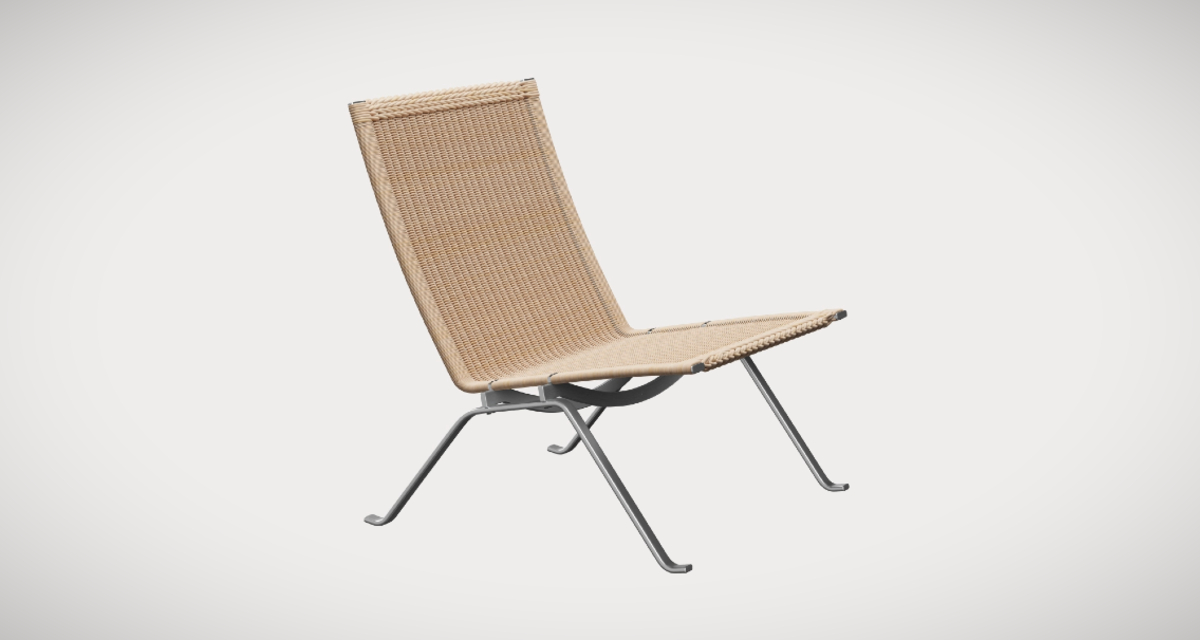
The PK22 Chair is built around a precise visual proposition: a slender steel frame defines the chair while allowing its seat and back to appear almost suspended within it. Its low silhouette brings the body closer to the ground, while the open construction preserves a sense of space around the object. Every element contributes to a carefully controlled composition of lines, surfaces and proportions. Rather than relying on ornament or expressive gestures, Poul Kjærholm establishes the chair’s identity through structural clarity and the deliberate relationship between materials. Its presence is architectural, shaped as much by what the frame leaves open as by what it supports.
Designed in 1956, the PK22 Chair emerged at a defining moment in Danish modern furniture. Poul Kjærholm was testing how industrial materials could carry the precision traditionally associated with cabinetmaking. Here, steel does not imitate wood or retreat into anonymous engineering. It becomes the principal language of the object.
The chair’s importance lies in this balance. Its construction is legible, its proportions carefully judged, and its surfaces invite use without overwhelming the room. More than six decades after its introduction, the PK22 remains a study in restraint, material intelligence and structural clarity. It shows how design can be distinctive without relying on novelty.
PK22 Chair Design as a System of Relationships
Kjærholm approached furniture through relationships: body and support, structure and surface, object and architecture. The PK22 Chair gives this thinking a concentrated form. Its low stance encourages a relaxed posture, while the backward inclination of seat and back creates repose without an oversized cushion. The sitter is supported, but the frame remains visible.
The structure is not concealed beneath upholstery. Thin steel members establish the geometry and carry the upholstered elements as distinct planes. The frame gives the PK22 its outline, the seat and back provide contact, warmth and comfort. Each component has a defined task, and their meeting produces the whole.
This logic makes the PK22 Chair feel like a small architectural system. The frame defines boundaries and carries loads, while leather, canvas, woven cane or wicker introduces a different tactile register. The materials retain their identities rather than merging into a single mass. Construction becomes the design language, not a technical matter hidden after the aesthetic decisions.
The absence of bulky arms and a heavy base gives the chair openness. Light passes through it and the floor remains visible. Its footprint is substantial enough for a lounge chair, yet its outline does not dominate a room. It is a place to sit that preserves the space around it.
Steel, Craft and the Human Body
Kjærholm’s interest in steel came from respect for the material, not a desire to make furniture look industrial. Trained as a cabinetmaker, he understood how materials shape touch, durability and character. He argued for steel to receive the artistic consideration long granted to timber. The PK22 Chair makes that proposition tangible.
Its frame uses slender, carefully finished steel sections. Controlled curves and junctions give the chair strength and an almost drawn quality. The metal is cool and precise, but the chair avoids austerity: the surfaces that meet the body introduce intimacy. Depending on the version, seat and back may be covered in leather, canvas, woven cane or wicker. These options alter texture without changing the underlying grammar.
The relationship between hard and soft is central. Steel provides a stable perimeter; the seating surface creates the immediate point of contact. Leather develops a patina through use. Woven cane brings porosity and openness. Neither treatment disguises the frame. Each makes the structure more apparent by contrast.
Kjærholm’s craft background appears in proportion, finish and the disciplined transition between materials, rather than ornament. The PK22 Chair is industrial in method but human in scale: a chair organised around the body, not the spectacle of engineering.
From the PK25 to the International Stage
The PK22 belongs to a longer investigation rather than appearing as an isolated invention. In 1952, while completing his studies at the School of Arts and Crafts in Copenhagen, Kjærholm designed the PK25, known as the Element Chair, as his graduation project. It used a continuous steel frame, reducing the structure to a single drawn line. The PK22 Chair, developed in 1956, carried forward that profile while refining its construction.
The change was practical as well as formal. The PK22 divided the frame into separate elements, making production more manageable and allowing improvements to comfort and assembly. This showed how a radical concept could become a more resolved piece of furniture through adjustment, retaining visual economy while accommodating manufacture and everyday use. Kjærholm’s study of the ancient Greek klismos chair also informed the PK22’s light, open profile, a historical typology translated through industrial means.
The chair belongs to the wider story of post-war Danish design, when makers and architects explored how craftsmanship could coexist with new materials and industrial production. Kjærholm’s path differed from the wood-centred language of many contemporaries. He treated steel as a material with expressive possibilities while maintaining a dialogue with natural upholstery materials.
The PK22 Chair was produced by Ejvind Kold Christensen, with whom Kjærholm began collaborating in 1955. In 1957 it received the Grand Prix at the Milan Triennale, bringing the designer international attention. The award recognised a balance between industrial precision and furniture craft, not a fashionable surface treatment.
Why the PK22 Chair Is a Time-Proof Design
The PK22 has survived changing interiors because its identity rests on principles more stable than fashion. First is structural honesty. The frame reveals how the chair is organised and where its support comes from. There is little confusion between what carries weight and what provides comfort. This clarity gives the object a legibility that does not depend on a particular decade’s taste.
Second is proportion. Low and composed, the chair is not theatrical. Its open frame adapts to different architectural settings, from a reading corner to a generous living room or public interior. It can sit beside a heavy sofa, a timber table or contemporary architecture without requiring the surrounding furniture to share its period.
Third is the distinction between permanent structure and variable experience. The steel frame establishes the design’s character, while upholstery and weaving introduce material variation. Finishes and covers can change the chair’s mood, yet the core composition remains recognisable. This allows adaptation without diluting its authorship.
The chair does not depend on a conspicuous motif, novelty mechanism or colour that dates it. Its interest comes from line, plane, tension and surface: fundamental design concerns that remain relevant as domestic habits and interiors evolve.
A time-proof object is not one that escapes history, but one whose ideas can be read in different circumstances. The PK22 Chair achieves this through durability of concept: a precise structure, expressive materials and comfort treated as part of form rather than an afterthought.
The PK22 Chair in Contemporary Interiors
Today, the PK22 Chair occupies an unusual position between functional furniture and collectible design. It appears in private homes, hospitality spaces, galleries and architectural interiors because it can establish a point of focus without filling the room. Its low profile works where architecture matters: the chair offers a place to pause while leaving sightlines intact.
Its continued production by Fritz Hansen has kept the design available to new generations. The Kjærholm Collection passed to the company in 1982, two years after the designer’s death, and the PK22 remains in its catalogue. Contemporary versions retain the essential composition while offering different upholstery and finish options. The chair is not simply preserved as a museum object; it remains usable furniture within an active design culture.
Its current appeal reflects interest in material quality and long-term ownership. Against interiors shaped by rapid trends and disposable furnishings, the PK22 proposes a slower relationship with objects. Leather changes with use; woven surfaces reveal their construction; steel acquires small marks that register a life in the room. These traces can add depth rather than diminish its presence.
Yet the PK22 is not universally comfortable like a deep, cushioned recliner. Its low seat and considered lounge posture make it a deliberate choice, suited to conversation, reading or a pause rather than sprawling informality. Its relevance depends on a particular idea of comfort: support with visual and physical lightness.
PK22 Chair Future Relevance: Continuity Without Imitation
The future of the PK22 Chair rests less on its status as a modern classic than on the questions it continues to ask. How little material can define a comfortable place to sit? How can an industrial structure retain warmth? When should a component remain visible, and when should it recede? These questions belong to responsible product design.
The PK22 offers a model for longevity because its identity is concentrated in a durable structural idea rather than a disposable feature. Its separable materials also make the chair easier to understand, maintain and reupholster than an object in which frame, padding and cover are fused into an opaque construction. Actual repairability depends on the condition of a particular chair and the availability of skilled restoration, but its legible components provide a sound starting point for care.
There is a further lesson in Kjærholm’s refinement of the PK25 into the PK22. Innovation did not mean protecting the first solution from change. It meant identifying what mattered in the original concept and improving the parts that stood in its way. That distinction is valuable now, when sustainability requires products to remain useful, serviceable and desirable.
The PK22 Chair should not be treated as a template to copy mechanically. Its enduring contribution is a method: begin with material reality, make structure intelligible, and let proportion do the expressive work. As interiors and technologies change, that method will remain productive. The chair’s quiet authority comes from having little to explain and very little to prove.