
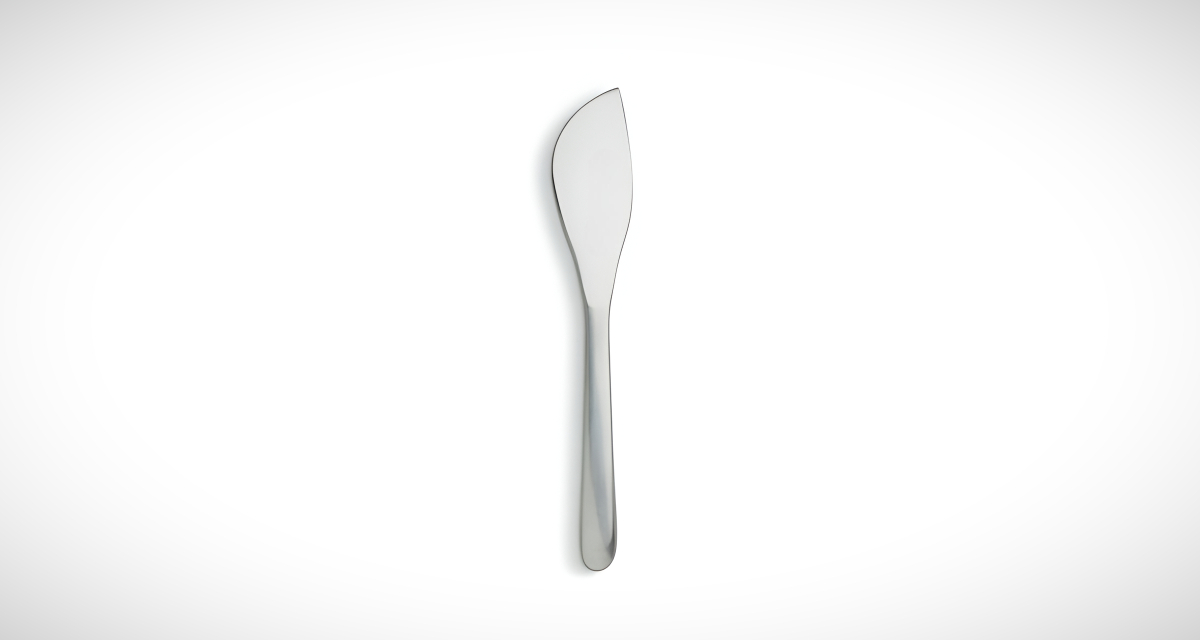
At first glance, it appears almost anonymous, a modest utensil resting on a breakfast table. Yet, in the hand, it reveals itself as something far more intentional, a refined expression of industrial design thinking distilled into a single gesture.
This butter knife is not about ornament or excess. It is about clarity of purpose, about how a small object can seamlessly integrate into human behavior. Its curved silhouette, balanced weight, and tactile comfort all work in quiet harmony. You don’t notice it immediately, and that is precisely the point.
Designed by one of Japan’s most influential modern designers, the knife embodies a philosophy where function and form are inseparable. It is not just a tool for spreading butter. It is a study in how design can elevate routine actions, turning the mundane into something subtly satisfying.
In a world saturated with disposable objects, the Sori Yanagi butter knife stands apart as a reminder that even the smallest items deserve thoughtful design. It invites us to reconsider what we hold in our hands each day and to recognize that true innovation often lies in restraint rather than spectacle.
Sori Yanagi Butter Knife Design Concept and Philosophy
At the heart of the Sori Yanagi butter knife lies a deeply human-centered approach. Yanagi did not begin with aesthetics. He began with use. How does butter behave? How does the hand move? Where does pressure naturally fall when spreading across bread?
The knife’s defining feature is its gentle asymmetrical curve, which subtly guides the motion of spreading. This is not accidental. The curve distributes pressure evenly, allowing butter to glide rather than resist. The blade is neither too sharp nor too blunt, achieving a delicate balance that supports control without aggression.
Equally important is the handle. Instead of a rigid separation between blade and grip, Yanagi created a continuous form. This continuity enhances ergonomics, allowing the hand to settle naturally. There are no visual interruptions, no unnecessary joints. Just one fluid line.
This reflects a broader design philosophy rooted in Japanese modernism, where simplicity is not reduction for its own sake, but a pursuit of essential truth. Yanagi’s work often draws from traditional craft while embracing industrial production. The butter knife captures this duality. It feels handcrafted, yet it is perfectly suited for mass production.
Material choice also plays a crucial role. Typically made from stainless steel, the knife offers durability and hygiene while maintaining a subtle tactile warmth. It does not feel cold or clinical. Instead, it feels reliable and familiar, qualities that build trust over time.
Ultimately, the design is not about standing out. It is about fitting in so well that it becomes indispensable.
Sori Yanagi Butter Knife Historical Context and Heritage
To understand the butter knife, one must look beyond the object itself and into the cultural and historical landscape that shaped it. Sori Yanagi emerged in post-war Japan, a period defined by reconstruction, identity, and the search for a new design language.
This era saw a fusion of traditional Japanese craftsmanship with Western industrial methods. Designers were tasked with creating objects that could be mass-produced without losing the spirit of hand-made quality. Yanagi stood at the center of this movement.
He was influenced by the mingei philosophy, which celebrated the beauty of everyday objects made for ordinary people. This philosophy rejected elitism in design and instead emphasized honesty, utility, and accessibility. The butter knife embodies these principles. It is not luxurious in the conventional sense, yet it carries a quiet dignity.
Historically, butter knives themselves have evolved from ornate tableware in European dining traditions to more functional forms in modern kitchens. Early designs often prioritized decoration over usability. Handles were carved, blades were embellished, and ergonomics were secondary.
Yanagi’s approach marked a clear departure. He stripped away excess and focused on how the object performs in real life. This shift mirrors broader trends in 20th-century design, where figures across the globe began to question ornamentation and embrace functionality.
In this context, the butter knife is not just a utensil. It is part of a larger narrative about how design evolved from decorative expression to human-centered problem solving.

Why It Is a Time-Proof Design
What makes a design endure? Why do some objects remain relevant decades after their creation while others quickly fade? The Sori Yanagi butter knife offers a compelling answer through its commitment to timeless design principles.
First, there is clarity of function. The knife does exactly what it is meant to do, and it does so exceptionally well. There are no gimmicks, no unnecessary features that might become outdated. This purity ensures longevity.
Second, the design embraces simplicity with depth. At a glance, it appears minimal. But closer inspection reveals a sophisticated understanding of form and ergonomics. This layered simplicity allows the object to age gracefully. It does not rely on trends, which are inherently temporary.
Another key factor is material integrity. Stainless steel does not just resist corrosion. It also communicates durability and permanence. The knife feels like it belongs, whether in a modern kitchen or a traditional dining setting.
Equally important is its emotional neutrality. The design does not impose a strong stylistic identity. Instead, it adapts to its surroundings. This flexibility makes it universally appealing across cultures and generations.
Finally, the knife embodies the principle of design invisibility. The best designs often disappear into the experience they create. When using this knife, one does not think about the object itself. One simply spreads butter with ease.
This quiet efficiency is what allows the design to remain relevant. It does not demand attention, yet it consistently delivers value.
Sori Yanagi Butter Knife Present-Day Relevance
In today’s design landscape, where sustainability and mindful consumption are increasingly important, the Sori Yanagi butter knife feels more relevant than ever. It stands as an example of long-lasting design in an age of disposability.
Consumers are becoming more aware of the environmental impact of their choices. They seek objects that are durable, repairable, and meaningful. The butter knife aligns perfectly with these values. It is not something to be replaced frequently. It is something to be kept, used, and appreciated over time.
There is also a renewed interest in tactile experiences. As digital interfaces dominate our lives, physical objects take on greater significance. The feel of the knife in the hand, the smooth motion across bread, these small sensory details become moments of grounding.
In contemporary kitchens, the knife fits seamlessly alongside both high-tech appliances and artisanal tools. It bridges different worlds, proving that good design does not need to compete for attention. It simply needs to work well and feel right.
Moreover, the rise of global design awareness has brought greater appreciation for figures like Yanagi. His work is studied, collected, and celebrated, not as relics of the past, but as living examples of thoughtful design practice.
The butter knife continues to be produced and used, not because of nostalgia, but because it remains genuinely useful. Its relevance is not constructed. It is earned through consistent performance.
Future Outlook
Looking ahead, the Sori Yanagi butter knife offers valuable lessons for the future of design. As technology advances and new materials emerge, the core principles embodied in this object remain profoundly important.
Future design will likely focus even more on human experience, sustainability, and emotional connection. The butter knife already addresses these areas with remarkable clarity. It demonstrates that innovation does not always mean adding complexity. Sometimes, it means refining what already exists.
There is also an increasing emphasis on design longevity. Products that can endure both physically and culturally will become more valuable. The butter knife sets a benchmark for this kind of resilience. It shows that when an object is designed with care and intention, it can transcend time.
In educational contexts, such designs will continue to inspire new generations of designers. They will study not just the form, but the thinking behind it. Why does it work? What decisions led to its final shape? These questions will remain relevant.
As global cultures continue to intersect, objects like this knife will serve as bridges. They carry within them a blend of tradition and modernity, offering a model for design that respects heritage while embracing progress.
Ultimately, the future will not diminish the importance of such objects. If anything, it will amplify their value. In a world of constant change, the Sori Yanagi butter knife stands as a quiet reminder that good design is not about novelty, but about enduring human connection.