
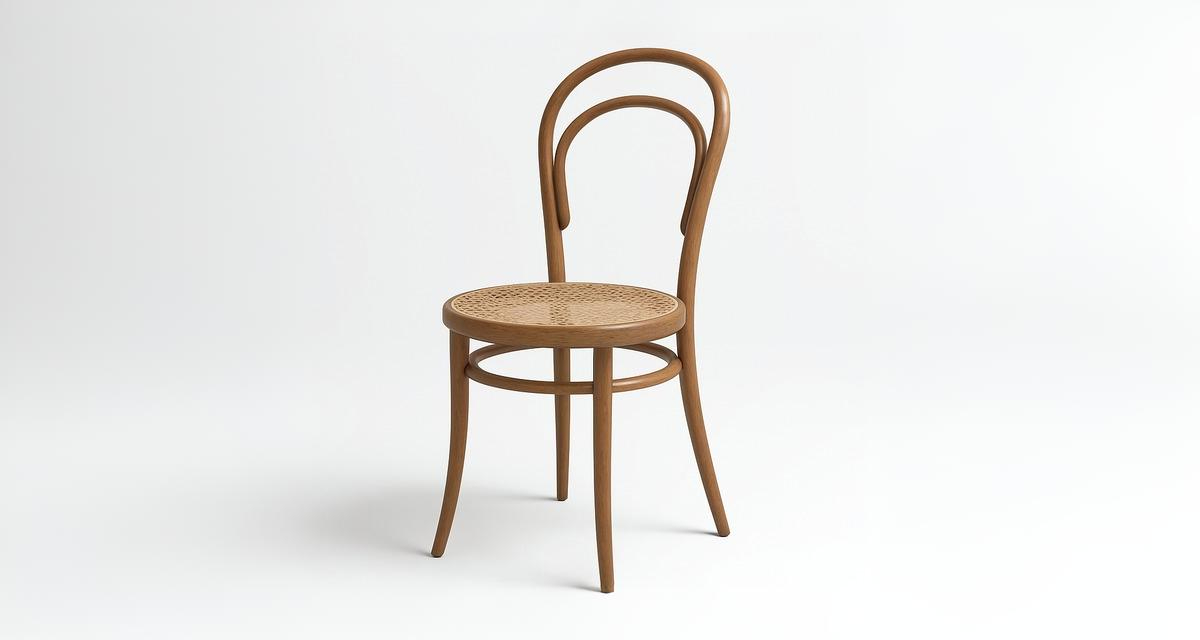
The Thonet Chair No. 14, known affectionately as the “bistro chair” have impacted our everyday world. This icon of 19th-century innovation represents a turning point not only in furniture design but in mass production, material efficiency, and aesthetic universality. From the smoky cafés of Vienna to modern-day loft apartments in New York and Berlin, the Chair 14 has stood resilient against time, taste, and trend.
But what makes the Thonet Chair 14 a true time-proof design? What philosophy shaped it, and why does it still matter in the 21st century and beyond?
Let’s unravel the story of the chair that revolutionized sitting.
Thonet Chair 14 Origins: Bending Wood and Breaking Norms
The story begins with Michael Thonet, a visionary German-Austrian cabinetmaker born in 1796. Thonet’s true breakthrough came when he mastered a technique that seemed to defy nature: bending solid beechwood into curves using steam. This process, known as bentwood, reduced the need for intricate joinery and enabled the creation of strong, lightweight, elegant furniture with minimal components.
After founding his company, Gebrüder Thonet, and gaining support from Prince Metternich of Austria, Michael relocated to Vienna, where his innovation would flourish. In 1859, Thonet introduced the Chair No. 14, a creation that would go on to be the most successful mass-produced chair in history.
By the early 20th century, over 50 million units had been sold, and today the number exceeds 80 million. These aren’t just statistics, they are a reflection of a design so intuitive and universal that it transcends borders and eras.
Design Concept: Simplicity Meets Ingenuity
What sets the Thonet Chair 14 apart is not flamboyance or extravagance, but restraint and intelligence. The chair consists of just six wooden parts, held together by ten screws and two nuts. This modular simplicity made it easy to ship and assemble, revolutionizing the logistics of furniture delivery long before flat-pack became a buzzword.
Each component was engineered with purpose:
- The curved backrest cradles the sitter, providing ergonomic support.
- The round seat, originally caned, is lightweight and breathable.
- The legs and stretchers offer rigidity while maintaining a visually light footprint.
The overall composition is both humble and harmonious. There are no excessive decorations, no flamboyant lines. Instead, it communicates with clarity and confidence.
A Democratizing Force in Design
The Chair 14 is often cited as one of the first pieces of democratic design. Before its invention, furniture was largely the domain of the wealthy, handcrafted by artisans in small quantities. Thonet’s approach opened the door to affordable beauty and functionality for the masses.
Due to its low production cost and high durability, the Chair 14 quickly found its way into cafés, restaurants, homes, and public institutions across Europe and beyond. Its success helped define the visual culture of the Belle Époque, contributing to a new kind of public space: the café as a social, artistic, and intellectual hub.

Influences and Inspirations: A Heritage of Design Evolution
While Chair 14 is often viewed as an endpoint of a process, it’s also the beginning of a lineage. The Thonet ethos influenced generations of designers:
- Le Corbusier, who famously filled his buildings with Thonet pieces, admired their purity and form.
- Alvar Aalto and Arne Jacobsen carried the legacy forward with their own experiments in curved wood.
- Even Charles and Ray Eames, decades later, would echo the idea of simplicity, lightness, and production efficiency.
This heritage is not just about imitation but about shared principles: form serving function, craft meeting industry, and beauty emerging from utility.
Time-Proof by Design: Why It Still Matters
Today, in a world overwhelmed by fleeting trends and disposable goods, the Thonet Chair 14 stands as a beacon of timeless relevance. Here’s why:
1. Sustainability: The bentwood technique uses less material and creates less waste than traditional methods. The chair is durable enough to last generations, making it an antidote to fast furniture.
2. Versatility: Whether it’s gracing a Parisian café or a Scandinavian-style kitchen, the Chair 14 blends effortlessly into its surroundings. Its neutrality is its superpower.
3. Human-Centric Design: Designed for comfort and ease of use, the chair still competes with ergonomic solutions today. It doesn’t scream for attention but wins affection over time.
4. Emotional Durability: People form attachments to Chair 14s. Found in family kitchens, university halls, and grand hotels, these chairs become part of personal and shared histories.
Celebrated Siblings: Other Thonet Chair 14 Classics
While Chair 14 is the crown jewel, Thonet’s catalog includes other time-defying models:
- Chair No. 18: A slight variation on the No. 14, featuring an elegant crossed backrest. Still a favorite in restaurants for its graceful appearance.
- Rocking Chair No. 1: Introduced in 1860, this design brought bentwood elegance to relaxation furniture.
- Armchair No. 209: A stunning single-piece armrest design, admired by architects for its sculptural form.
These models share a core philosophy: clarity, economy, and elegance.

The Digital Age: A New Chapter for a Classic
In the 21st century, the Chair 14 has been reimagined and reissued by brands like THONET GmbH, which continues to produce bentwood furniture using original techniques enhanced by modern engineering.
Additionally, contemporary designers and creatives have embraced the Chair 14 as a canvas for reinterpretation. Limited editions, artistic collaborations, and eco-conscious updates have breathed new life into the form while respecting its roots.
On Instagram and Pinterest, Chair 14 appears in interior design blogs, architectural portfolios, and minimalist lifestyle features. Its photogenic quality adds to its cultural momentum, bridging analog legacy with digital relevance.
Future-Proof: How Thonet Chair 14 Will Stay Relevant
In a future increasingly concerned with sustainability, longevity, and authenticity, the Chair 14 is uniquely poised to thrive. As consumers move away from novelty and toward intentional living, products like this gain renewed importance.
Expect to see Chair 14 in:
- Net-zero buildings as part of a responsible design ethos.
- Biophilic interiors, where natural materials and tactile experiences matter.
- Collaborative workspaces, where flexibility and comfort are key.
Its adaptability ensures it will continue to be not just a piece of furniture, but a symbol of enduring design wisdom.
Closing Thoughts: The Curve That Changed Everything
When Michael Thonet bent his first beechwood slat, he didn’t just shape a chair. He shaped the future of design.
The Thonet Chair 14 is more than an object. It is a cultural artifact, a pioneer of industrial design, and a living lesson in how simplicity, functionality, and beauty can coalesce into something eternal.
As we face a world that demands thoughtful consumption and authentic experiences, the Chair 14 remains a benchmark. It doesn’t just occupy space, it enhances it, quietly and confidently.
From Vienna to the world, from 1859 to tomorrow: the chair that changed everything is still changing the way we sit, think, and live.
Timeless? Absolutely. Time-proof? Undeniably.