
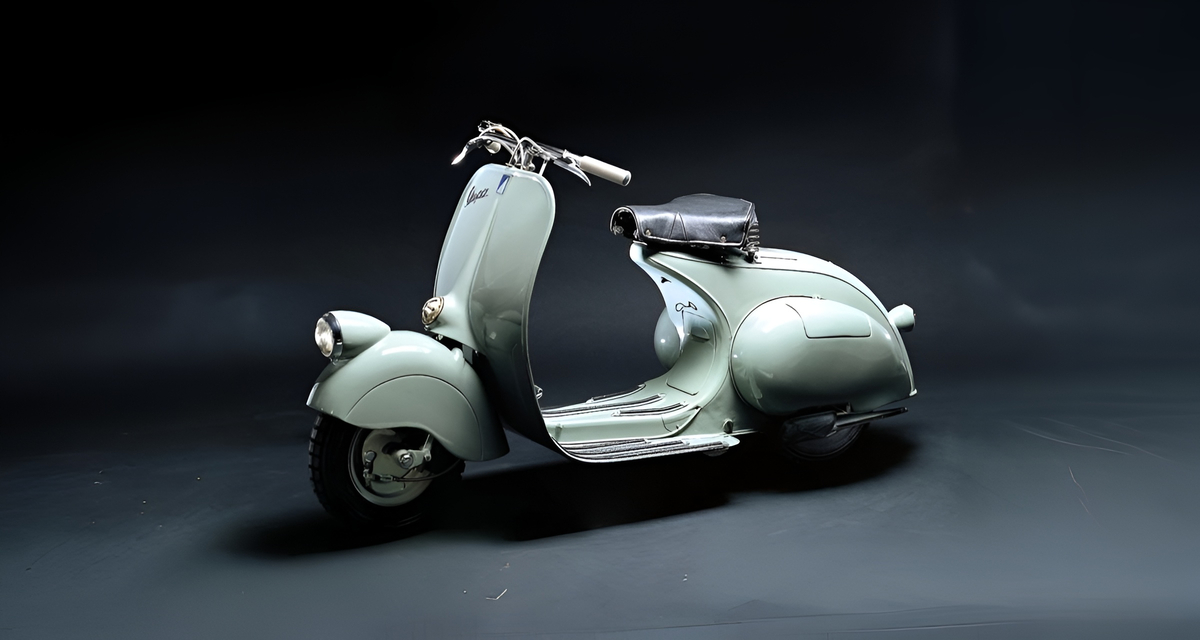
The Vespa 98 Scooter represents an idea shaped into steel, motion, and cultural meaning. Introduced in 1946, this compact vehicle transformed personal transportation and redefined industrial design for everyday life. While many products remain tied to the period that created them, the Vespa 98 continues to feel current, desirable, and emotionally relevant. Its lasting appeal comes from a rare balance of human centered thinking, engineering clarity, and cultural sensitivity.
This article explores the history of the Vespa 98 Scooter, the design approach behind its creation, its evolution across decades, and the reasons its form continues to resonate today and will remain relevant in the future. From post war Italy to modern cities, the Vespa story reflects empathy, innovation, and restraint.
Vespa 98 Scooter Origins in Post War Italy
After World War II, Italy faced widespread reconstruction. Roads were damaged, fuel was scarce, and private cars remained out of reach for most citizens. Despite these challenges, daily life needed to restart. Workers required transportation, families needed independence, and cities needed efficient movement.
At this critical moment, Piaggio was forced to redefine its purpose. Formerly dedicated to aircraft production, the company had to pivot due to post war restrictions. Its factories, materials, and engineers required a new mission.
Rather than following existing motorcycle conventions, Piaggio pursued a different goal. The company aimed to create an affordable, reliable, and easy to use vehicle designed for everyday people. This social and economic context shaped every design decision behind the Vespa 98 and explains why its design feels grounded and authentic.
Vision, Leadership, and a Radical Design Perspective
The strategic vision behind the project belonged to Enrico Piaggio. He believed transportation should be accessible across age, gender, and profession. Riding should feel intuitive and comfortable, without requiring physical strength or mechanical knowledge.
To achieve this, Piaggio selected Corradino D’Ascanio as lead designer. D’Ascanio brought an unconventional advantage. He disliked traditional motorcycles, finding them dirty, unstable, and intimidating.
This dislike became a creative catalyst. Instead of refining an existing category, D’Ascanio ignored it entirely. His aeronautical background encouraged him to think in terms of balance, structural efficiency, and user comfort. As a result, the Vespa 98 emerged as a completely new type of vehicle.
Vespa 98 Scooter Human Centered Design Concept
The Vespa 98 Scooter introduced a design philosophy built around real human behavior. Every element responded to how people dressed, moved, and interacted with machines in daily life.
One of the most influential innovations was the step through frame. Riders could mount the scooter effortlessly, keeping clothing clean and movement natural. This decision expanded the audience significantly and removed the physical intimidation associated with motorcycles.
Another defining feature was the monocoque steel body. Instead of a tubular frame, the body itself carried structural loads. This approach reduced weight, increased rigidity, and created a protective shell around the rider. Mechanical components remained hidden, reducing visual clutter and simplifying maintenance.
The engine mounted on one side of the rear wheel balanced the scooter while eliminating the need for an exposed chain. The front suspension system, inspired by aircraft landing gear, improved stability on uneven roads.
Each decision followed logic, empathy, and efficiency, resulting in a form that felt inevitable rather than styled.
Naming, Identity, and Emotional Connection
When Enrico Piaggio first observed the prototype, its shape immediately suggested an organic form. The narrow waist, rounded rear, and buzzing sound reminded him of a wasp. The name Vespa, meaning wasp in Italian, captured this character perfectly.
This naming choice reinforced emotional connection. The scooter felt animated, friendly, and approachable. It carried personality without decoration or excess. That emotional quality helped people form long term attachment, turning the Vespa into a companion rather than a disposable object.
Vespa 98 Scooter Early Production and Market Adoption
Production of the Vespa 98 began in 1946 with modest expectations. Initial reception was cautious, as the concept challenged conventional ideas of two wheeled vehicles. However, once people experienced the scooter, attitudes changed rapidly.
Riders appreciated the upright seating position, ease of control, and low learning curve. Maintenance was straightforward, fuel consumption was efficient, and the scooter navigated narrow streets with ease.
By 1949, sales increased dramatically. The Vespa became a visible symbol of recovery and personal freedom. It enabled independence during a period when mobility represented hope and progress.
Vespa 98 Scooter Cultural Influence and Global Expansion
As production expanded, the Vespa gained international recognition. It became associated with urban life, youth culture, and modern identity. Films, photography, and advertising helped position the Vespa as part of a new lifestyle centered on movement and freedom.
Despite updates and new models, the visual language introduced by the Vespa 98 remained consistent. Rounded volumes, compact proportions, and a protective body defined the brand. This continuity strengthened recognition and trust.
Licensing agreements allowed production in multiple countries, spreading the Vespa concept worldwide. The scooter adapted to different cultures while maintaining its core identity.
Design Evolution Without Losing Identity
Over the decades, Vespa scooters evolved to meet new standards, technologies, and user expectations. Engines became stronger and cleaner. Safety features improved. Materials advanced.
Yet the fundamental design principles introduced by the Vespa 98 stayed intact. The body remained a unified form. The riding position stayed relaxed and intuitive. The scooter continued to shield the rider rather than expose them.
Even as materials shifted and features modernized, the design language respected its origins. This disciplined evolution prevented visual fatigue and preserved emotional continuity.
Why the Vespa 98 Scooter Represents Time Proof Design
Timeless design emerges from clarity of purpose rather than ornament. The Vespa 98 Scooter achieved longevity by addressing genuine needs with thoughtful solutions.
Carefully considered proportions create balance through ergonomic design principles. Structural and protective requirements shape natural, flowing curves. A refined sense of simplicity emerges from the intentional removal of unnecessary elements.
Rather than chasing trends, the Vespa focused on everyday life. This approach allowed it to age gracefully and remain relevant across generations.
The scooter belongs to a way of living rather than a specific decade.
Sustainability Embedded in the Original Concept
Long before sustainability became a design requirement, the Vespa 98 aligned naturally with responsible principles. Compact size, efficient fuel use, and long product lifespan defined its original intent.
Many early Vespas remain operational today, restored and maintained by dedicated owners. This durability reduces waste and strengthens emotional attachment. Designing products meant to last physically and emotionally has become essential in contemporary design, and Vespa demonstrated this approach early on.
Vespa in the Era of Electric Mobility
As cities move toward electric transportation, the Vespa philosophy continues to adapt. Electric Vespa models reinterpret the same principles using new technology.
The experience remains familiar. Quiet movement, compact efficiency, and approachable aesthetics define the ride. The Vespa 98 serves as a conceptual foundation for this transition, proving that innovation and heritage can coexist.
Lessons for Designers and Creators
For industrial designers and product creators, the Vespa 98 offers lasting lessons. First, begin with empathy. Understanding daily rituals leads to meaningful solutions. Second, question assumptions. True innovation often emerges when categories are reimagined. Third, balance engineering and emotion. Objects should perform well and feel right.
Finally, design for longevity. Products that respect users earn long term loyalty.
A Design Philosophy That Still Shapes the Future
Looking forward, the Vespa 98 Scooter will continue to inspire new generations of designers. Its influence appears in urban mobility systems, compact vehicles, and user focused products.
As cities grow denser and sustainability becomes essential, the Vespa vision remains highly relevant. It shows that progress can emerge from simplicity, clarity, and care.
Final Thoughts
The Vespa 98 Scooter stands as a landmark in industrial design history. Born from economic necessity and shaped by empathy, it created a new approach to mobility.
Its form remains familiar because its purpose remains relevant. Its design endures because it respects human experience.
In a rapidly changing world, the Vespa 98 reminds us that thoughtful design, grounded in real life, holds the power to remain meaningful for generations.