
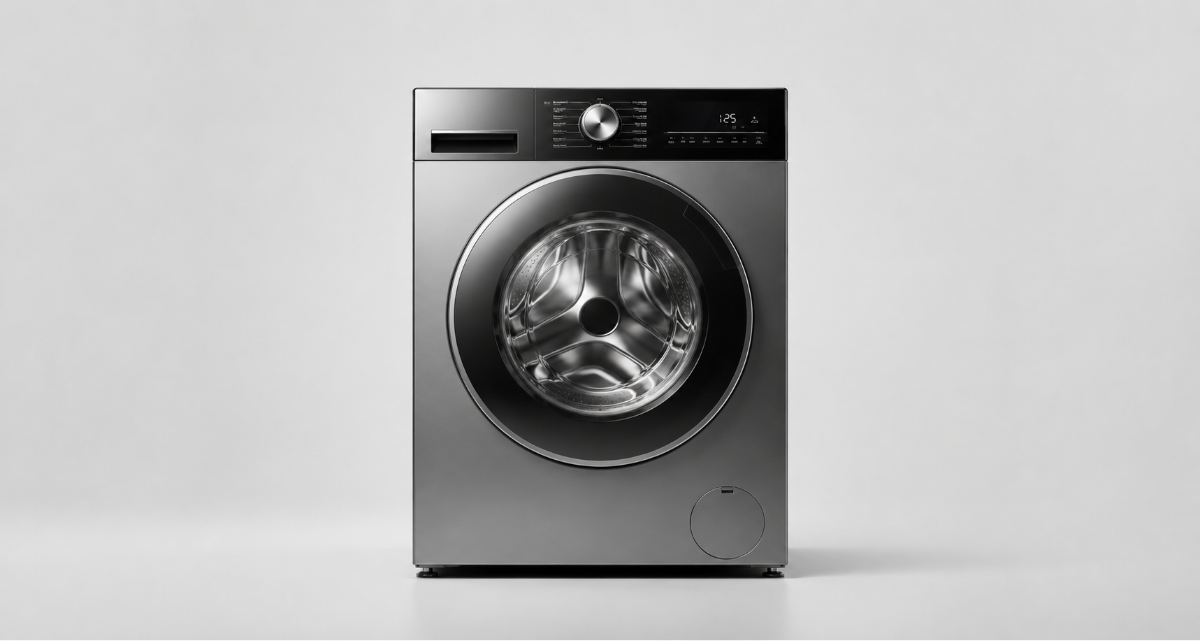
The washing machine occupies a modest physical space, usually against a wall or beneath a worktop, yet its cultural consequences are enormous. The machine transformed laundry from an exhausting manual process into an automated domestic routine, altering the organization of time, household labour, hygiene, architecture, and even expectations of cleanliness.
Before mechanization, washing clothes demanded considerable physical effort. Water had to be collected, heated, carried, agitated, rinsed, wrung, and often beaten or scrubbed by hand. Early washing devices therefore emerged from a practical question: how could mechanical movement reproduce the physical actions required to clean fabric? Nineteenth-century patent models already experimented with paddles, tubs, levers, and other mechanisms. The Smithsonian, for example, records American washing-machine patents from the 1870s, revealing how rapidly inventors began treating laundry as an engineering problem.
The washing machine consequently became a remarkable design object because its success depended on translating invisible processes into an understandable physical experience. A rotating drum, a measured quantity of water, carefully timed agitation, controlled temperature, and a final spin perform hundreds of mechanical decisions without demanding technical knowledge from the user.
That principle remains central today. Good laundry design hides complexity while preserving control. The machine works quietly in the background, yet its design embodies a long history of engineering, ergonomics, domestic culture, and resource management.
Washing Machine Design Concept and Philosophy
The fundamental design challenge of a washing machine is deceptively difficult. Cleaning clothing requires the interaction of water, chemistry, temperature, mechanical action, time, and fabric care. A successful machine must coordinate all of these variables while presenting the user with a comprehensible interface.
Early machines exposed much of their mechanism. Levers, wooden tubs, belts, wringers, and visible moving parts communicated how the machine worked. As technology developed, designers increasingly concealed this complexity. The appliance became a sealed system, with the user interacting through a smaller number of gestures: load, select, start, unload.
This evolution reflects a broader principle in industrial design: the best interface compresses a complicated operation into an intuitive sequence.
The circular door of the front-loading machine is a particularly effective example. Its geometry communicates both function and access. A circular aperture accommodates the rotating drum while giving the user a clear visual connection with the contents. The door becomes an interface, a safety boundary, and a visual signature at the same time.
Control systems evolved similarly. Dials once provided a physical map of washing cycles. Buttons, digital displays, sensors, and programmable systems now expand the machine’s capabilities. Yet the fundamental interaction remains remarkably stable. Users still need to answer simple questions: What am I washing? How dirty is it? Which treatment is appropriate? How long should it take?
Human-centred design therefore means reducing cognitive effort without reducing useful choice. The machine should understand the complexity, not force the user to become an engineer.
Historical Context and Heritage: From Labor to Automation
The washing machine emerged from a much older history of domestic labour. For centuries, washing depended on human strength and local infrastructure. The arrival of mechanical washing devices during the nineteenth century began separating cleaning performance from physical effort.
Early inventions varied considerably. Some used rocking mechanisms, others paddles, pressure systems, or rotating components. Their shared ambition was simple: reproduce the movement of hand washing mechanically. Smithsonian collections preserve examples of this inventive period, including a washing-machine patent model dated 1870 and further wooden washing machines patented in the 1870s.
Electrification accelerated the transformation. In the early twentieth century, motor-driven washing machines began combining mechanical movement with greater consistency and reduced manual intervention. A Smithsonian record describing an early automatic electric washer notes a 1910’s motor-driven Maytag machine, which integrated washing and wringing into a powered process.
The next major change was cultural as much as technological. During the twentieth century, the washing machine increasingly became a standardized household appliance rather than an experimental machine. The freestanding cabinet, circular door, control panel, tub, drum, motor, pump, and suspension system gradually formed a recognizable product language.
That standardization matters. Industrial design turns technological maturity into visual and functional familiarity. Once users understand the logic of one machine, they can approach another with relatively little learning. The washing machine became part of a global domestic vocabulary.
Its heritage therefore extends beyond engineering. It belongs to the history of modern domestic life, where machines increasingly reorganized repetitive tasks and redistributed the value of human time.
Why the Washing Machine Is a Time-Proof Design
The washing machine has survived enormous changes in technology because its essential proposition remains stable: mechanize repetitive labour while protecting the user from unnecessary complexity. This is the core of its time-proof character.
Consider the machine’s basic architecture. Whether a model is decades old or equipped with sensors and network connectivity, it still requires a vessel for water and fabric, a mechanism for movement, controlled drainage, and a way to remove excess water. Technology changes the efficiency and precision of these operations, but the underlying design problem remains recognizably human.
Its durability as a design idea also comes from functional clarity. The door opens where the clothes go. The drum rotates because movement cleans. Water enters and leaves through defined pathways. Controls correspond to identifiable washing conditions. Physical causality remains legible even when the internal engineering becomes sophisticated.
This echoes principles associated with enduring modernist design: economy of form, clarity of purpose, reduction of unnecessary elements, and close integration between function and structure.
Yet time-proof design should not be confused with visual nostalgia. A machine does not become enduring because it resembles an object from the past. It becomes enduring when its fundamental logic can absorb technological change without becoming obsolete in concept.
The washing machine demonstrates this remarkably well. Automatic dosing, sensor-assisted programs, variable-speed motors, remote monitoring, and increasingly precise water management can be introduced without abandoning the essential experience.
Its greatest strength is therefore adaptability.
Present-Day Relevance: Washing Machine as an Environmental System
Today’s washing machine operates within a very different design landscape. The central question has expanded from convenience to resource efficiency, repairability, material responsibility, and long-term ownership.
European regulation illustrates this shift clearly. Washing machines sold in the European Union are subject to ecodesign requirements and energy-labelling rules. Since March 2021, these rules have included requirements surrounding the Eco 40-60 and 20°C programs, while the energy label communicates electricity consumption, water use, programme duration, capacity, spin performance, and noise.
The transformation is measurable. According to the European Commission, average washing-machine electricity consumption decreased substantially between 1990 and 2020, while water consumption also fell. The Commission estimates that ecodesign and labelling measures helped reduce electricity use and water demand compared with a scenario without those measures.
Equally significant is the renewed emphasis on repairability. European ecodesign rules introduced requirements intended to improve maintenance and access to spare parts, including components such as door hinges, seals, locks, and detergent dispensers.
This changes the industrial-design brief. A successful appliance should no longer be evaluated solely through appearance, capacity, or programme count. Its quality also resides in how intelligently it ages.
A time-proof washing machine should consume less, communicate clearly, tolerate years of use, support maintenance, and avoid unnecessary technological complexity. Sustainability, in this sense, becomes a design property rather than a marketing accessory.
The Psychology of Laundry Design
There is another dimension that deserves attention: laundry is an intensely repetitive activity, and repetition magnifies small design decisions.
A poorly designed control panel can create irritation hundreds of times over its lifespan. A difficult detergent drawer can turn a trivial action into a recurring frustration. Excessive vibration, excessive noise, confusing symbols, or a door that is awkward to access can quietly degrade the experience of an otherwise capable machine.
Good product design recognizes this accumulation.
The washing machine therefore operates at the intersection of ergonomics and routine. Users rarely approach it with curiosity. They approach it while cooking, preparing for work, cleaning a home, raising children, or managing a busy schedule. The machine must accommodate distraction and partial attention.
This explains why familiar interaction patterns matter so much. A tactile dial, a large door handle, a clear cycle indicator, or a visible progress display can provide reassurance without demanding conscious interpretation.
There is also an important emotional dimension. Clean clothes represent order, care, preparation, and social confidence. The machine participates indirectly in all of these things. Its design supports a ritual whose final result is experienced outside the appliance itself.
The best laundry appliance disappears into the rhythm of everyday life. Its success is measured partly by how little attention it demands.
That quietness is a sophisticated design achievement.
Future Outlook: Designing for Adaptability
The next generation of washing machines will probably become increasingly connected, sensor-driven, efficient, and software-defined. Artificial intelligence may improve fabric recognition, load assessment, detergent dosing, stain treatment, and predictive maintenance. Connectivity may allow machines to communicate energy prices, diagnose faults, or coordinate with household energy systems.
Yet the future of washing-machine design should not be defined by technological accumulation.
The deeper opportunity is to make the appliance more adaptive while making the experience simpler.
Future machines could become better at recognizing what users actually need, rather than presenting an ever-expanding catalogue of programs. They could monitor their own mechanical condition, identify inefficient behaviour, guide maintenance, and extend component life. Their software could evolve without requiring the physical machine to become disposable.
This is where the idea of time-proof design becomes particularly relevant. A durable future appliance should separate what must remain stable from what can evolve.
The structural architecture, repairable components, efficient motor, drum, seals, and safety systems should be engineered for longevity. Software, interfaces, and optimisation algorithms can change over time. Such separation allows technological progress without automatically turning yesterday’s machine into tomorrow’s waste.
The washing machine has always been an instrument for saving human effort. Its future role is to expand that principle toward saving resources, extending product life, and simplifying decisions.
The enduring washing machine, therefore, will not be the one with the greatest number of features. It will be the one that understands the purpose of laundry so thoroughly that every component, interaction, and technological improvement serves it.
Washing Machine Design: A Quiet Definition of Modern Life
The washing machine rarely receives the cultural attention given to chairs, automobiles, cameras, or computers. Yet its influence may be broader than many celebrated design objects.
Transformed physical labour into automated process. Helped standardize domestic hygiene. It introduced industrial technology into one of the most repetitive areas of everyday life. Also demonstrated how industrial design can change behaviour without demanding attention.
Its visual language has changed repeatedly, but its conceptual foundation remains remarkably resilient. Water still moves through fabric. A drum still creates mechanical action. A cycle still converts time, energy, and chemistry into cleanliness. The machine remains a carefully orchestrated meeting point between engineering and human routine.
That continuity explains its significance as a time-proof design.
The washing machine succeeds because it continually changes without abandoning its purpose. Its future will demand greater efficiency, easier repair, responsible materials, quieter operation, and more intelligent interfaces. Those challenges are substantial, but the design principle at its centre remains clear.
Laundry may be an ordinary task, but the washing machine reveals how extraordinary thoughtful design can become when it enters the fabric of everyday life.
Make difficult work easier. Do complex technology understandable. Design the object to last.