
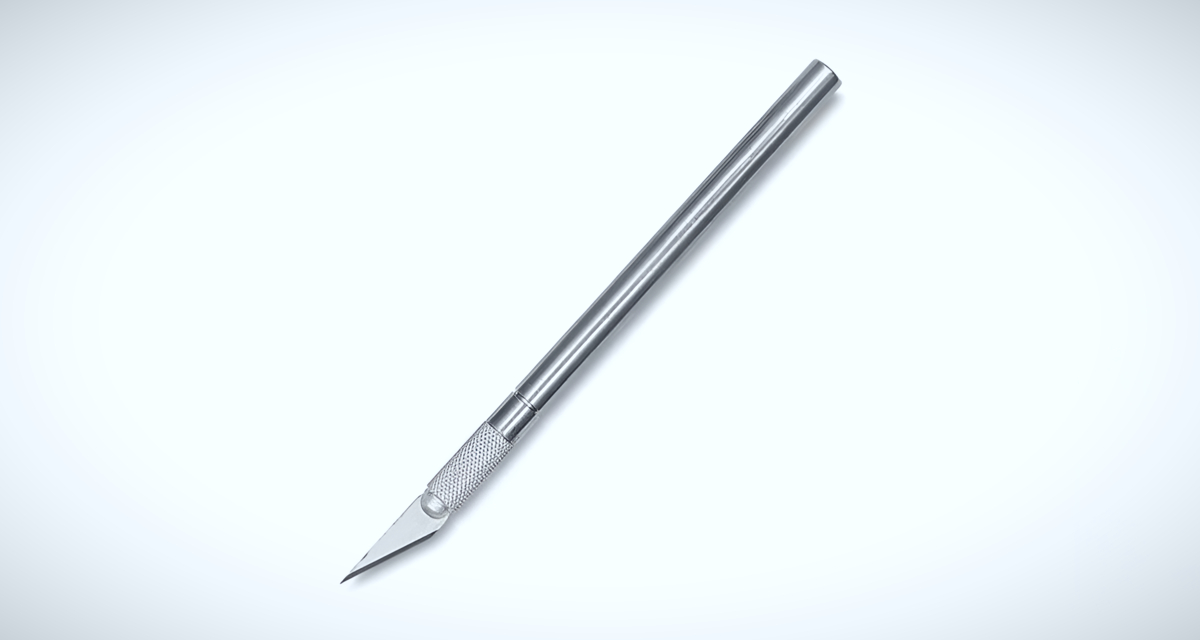
The X-Acto knife remains an enduring symbol of precision and timeless design. First introduced nearly a century ago, the X-Acto knife has carved out an iconic place in the toolboxes of architects, artists, model makers, designers, engineers, hobbyists, and tinkerers alike. Its enduring popularity across generations and professions speaks to something rare in the world of industrial design: a form and function so refined, it never needed reinvention.
This is the story of a cutting tool that became a design archetype, a case study in utility meeting elegance, and a beacon for how even the most utilitarian objects can be time proof through thoughtful creation.
X-Acto Knife Origins: A Surgeon’s Dream Turned Designer’s Best Friend
To understand why the X-Acto knife has remained relevant for so long, we must journey back to 1930s New York. The knife was originally conceived not as a craft tool, but as a surgical instrument. Sundel Doniger, the founder of the X-Acto company, wanted to provide surgeons with a precision cutting blade for delicate procedures. Ironically, the medical world did not embrace the tool, but its unique capabilities soon caught the attention of graphic designers and architects, who quickly adopted it for their own cutting and trimming needs.
And just like that, a tool intended for operating rooms found new life in design studios, architecture firms, art schools, and later, virtually every home with a DIY spirit.
Anatomy of a Classic: Why the X-Acto Knife Design Endures
The brilliance of the X-Acto lies in its elemental simplicity. At its core, it consists of a slender handle, a removable and replaceable blade, and a mechanism to hold the blade tightly in place. This trifecta forms a tool that’s immediately intuitive, satisfying to use, and adaptable to a vast range of materials.
The form has changed little since its invention. The X-Acto No. 1 knife, perhaps the most recognizable model, features a knurled aluminum barrel for grip, a lightweight body for control, and a razor-sharp blade for accuracy. The replacement blades, particularly the #11 blade, a true icon in itself, have remained unchanged for decades because they simply work perfectly.
Few products can claim this kind of stability without obsolescence. It’s not nostalgia that keeps it in circulation, it’s functional brilliance.
An Icon of Industrial Design: Timeless by Nature
Great industrial design often follows a quiet philosophy: do the job, do it well, and do it without calling unnecessary attention to itself. The X-Acto knife achieves this. It doesn’t require smart features, LEDs, ergonomic gimmicks, or buzzwords. Its design is transparent, meaning it disappears when in use. You don’t notice the knife, you notice what it allows you to create.
It embodies principles shared by other design legends: the Leica camera, the Eames chair, the Zippo lighter. All are built on the harmony between form, utility, and user experience. They gain status not by shouting, but by working flawlessly over time.
In that sense, the X-Acto knife is a quiet revolution, a piece of utilitarian poetry in aluminum and steel.
Tools of the Trade: Cultural and Creative Impact
From cutting film in the early days of photography, to slicing through board game prototypes, fashion pattern mockups, architectural models, or even vinyl lettering, the X-Acto became a core instrument in almost every field where precision matters.
It was instrumental in analog publishing, helping editors cut and paste articles before digital layout existed. Artists used it for collage, stencil work, and paper sculpture. Students in design schools worldwide quickly found that the X-Acto was the first tool issued to them, the first one they truly trusted. It crossed boundaries. It transcended trends.
One of the X-Acto most underappreciated roles was in Hollywood special effects. Before CGI, miniature model makers sculpted worlds by hand. Spaceships, cities, alien landscapes, all crafted with X-Acto knives slicing foam, styrene, and cardboard with surgical precision.
Built for Forever: X-Acto Knife Lesson in Sustainable Design
There’s a growing conversation around sustainability in design. Products must last, be repairable, use fewer resources, and avoid disposability. The X-Acto knife, quietly and without fanfare, fits these goals perfectly.
It’s modular: blades are replaceable, handles are durable, and nothing is wasted. The average aluminum handle can last decades, and often does. The packaging is minimal. The design avoids plastics where possible. In a world drowning in planned obsolescence, the X-Acto is a rare example of sustainable permanence.
X-Acto Knife Key Models That Shaped the Legacy
While the brand has evolved and expanded, several models stand out as time proof staples:
- X-Acto No. 1 Knife with #11 Blade
This is the gold standard. Used for paper, thin wood, film, and plastics. Lightweight and balanced, it’s the default knife for countless professionals and students alike. - X-Acto Gripster Knife
A more recent evolution, offering a rubberized grip for comfort during extended use. Still honors the original spirit but adapts slightly for contemporary ergonomics. - X-Acto X2000 Knife
A modern reinterpretation with a soft handle and anti-roll shape, made for those seeking both comfort and control. - X-Acto Heavy Duty No. 2 Knife
Larger and designed for tougher materials. Shows how the core design can scale while retaining its core identity.
Despite the variations, the lineage is unmistakable. Each model speaks the same design language.
The Emotional Bond of Tools That Last
There’s a strange and wonderful truth about tools like the X-Acto knife: over time, they develop a relationship with their user. They’re not just tools, they become companions in the act of creation.
Ask any illustrator, model maker, or design student, and they’ll likely remember their first X-Acto knife. The weight of it in their hand. The click of the blade locking in. The first perfect cut.
These tools bear traces of use, scratches, smudges, tiny dents, but those marks aren’t flaws. They’re histories. Evidence of ideas made real.
Why the X-Acto Knife Will Remain Relevant for the Next 100 Years
The X-Acto thrives because it aligns with universal creative needs:
- Precision: Technology may change, but the need for control over a cut will never fade.
- Versatility: It adapts to countless materials and tasks.
- Durability: Made to last. Made to repair.
- Simplicity: Nothing unnecessary. Everything essential.
- Affordability: High design without high cost.
No digital tool can entirely replace the tactile, intuitive power of the X-Acto knife. As long as people work with physical materials, whether in education, art, prototyping, or beyond, the knife remains essential.
Moreover, as the world becomes increasingly digitized, hands-on creativity has gained renewed value. Craft, handmade work, analog methods, they’re not vanishing. In fact, they’re growing in cultural importance. And the X-Acto is right there at the heart of it.
A Living Legacy in Design Museums and Workbenches
It’s no exaggeration to say that the X-Acto knife deserves a place in every design museum. In fact, many exhibitions on 20th-century tools and design include it as an example of the “invisible object” that shaped entire industries without opulence.
But its most important home is not in glass cases. It’s in the cluttered drawer of a model shop. The pencil case of a student. The cutting mat of a designer refining a prototype. The workbench of a miniature builder sculpting impossible worlds.
Conclusion: Cutting Through Time With Design That Endures
The X-Acto knife is not an accidental success. Its longevity is no fluke. It is the product of intentional, user-focused thinking, refined just enough over the years without losing the core of what made it exceptional in the first place.
It’s a reminder that great design doesn’t need reinvention. Sometimes, it needs respect. And in a world constantly seeking the next big thing, tools like the X-Acto ground us in the timelessness of good thinking, well-executed.
From its surgical roots to its designer legacy, from school projects to sci-fi movie sets, from delicate paper cuts to bold creative visions, the X-Acto knife has sliced through decades, disciplines, and ideas, and will continue to do so for generations to come.
So the next time you pick up your X-Acto knife and make that clean, deliberate incision, know that you’re not just cutting through material. You’re participating in a living design tradition, one of the most quietly powerful ever created.