
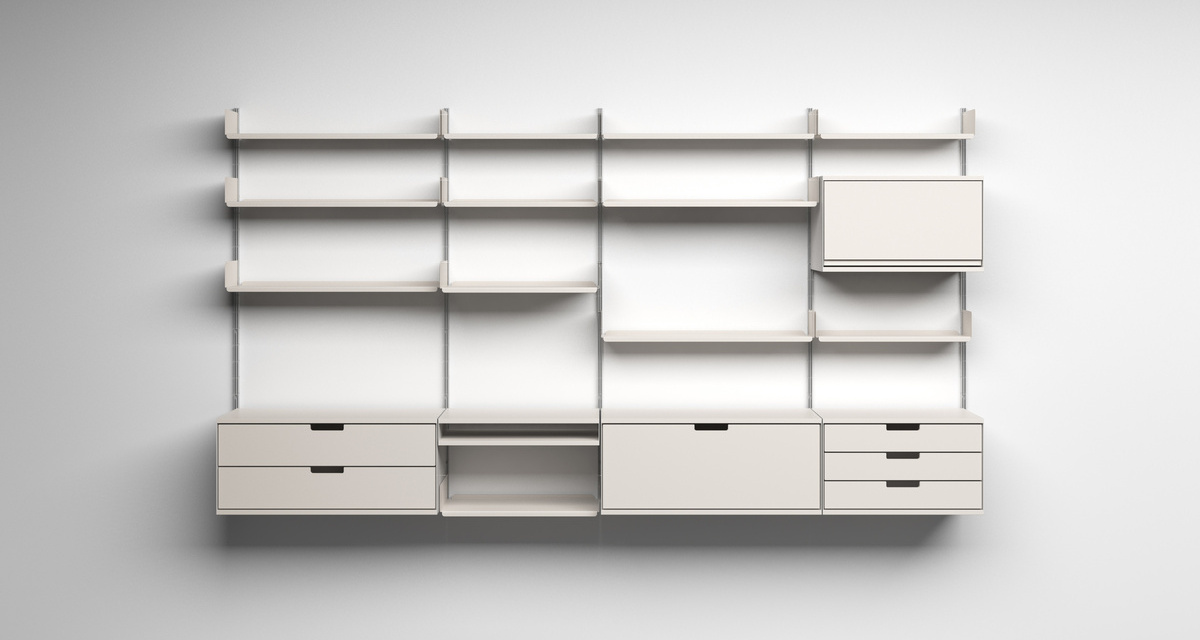
The 606 Universal Shelving System, conceived in 1960 by the visionary German industrial designer Dieter Rams, is a modular shelving system that stands as a paragon of timeless design, seamlessly integrating form and function to meet the changing needs of users across generations.
This article explores why the 606 Shelving System is a time-proof design, tracing its origins, underlying philosophy, and how it remains just as relevant today, and in the future, as it was when it first emerged during the golden age of modernist design.
The 606 Shelving System, Born Out of Design Integrity
The story of the 606 begins at Braun, the German electronics company where Dieter Rams served as Head of Design. In the late 1950s and early 1960s, Braun was redefining consumer products through minimalist, functional design. Rams sought to extend that same philosophy into the living environment. He envisioned furniture that wouldn’t shout for attention but would quietly support the life happening around it.
Together with Niels Vitsœ and Otto Zapf, Rams brought the 606 to life. Their goal was to create a modular system, something that could grow, shrink, or transform depending on the space and the user’s needs. Instead of being bound by one function, the 606 was designed to support many.
Unlike bulky furniture of the time, which was often room-specific and immobile, the 606 introduced a flexible approach to storage and organization. Books, records, artwork, plants, tools, the system could hold it all.
Core of the Design: Thoughtful Engineering Meets Simplicity
At its heart, the 606 is a study in restraint and precision. The system is made up of:
- Aluminum E-Tracks, which are mounted to a wall or floor-to-ceiling posts.
- Modular shelves and cabinets, designed to be slotted into the tracks.
- A range of accessories including desks, drawers, and display units.
What makes the 606 so exceptional is how effortlessly it scales. It can be a single column of shelves in a tiny city studio or stretch across an entire wall in a university library. You can start with just a few components and expand it over time. Each piece is designed to be compatible with every other piece, past or present.
This continuity is rare in a consumer landscape increasingly built around disposability and planned obsolescence. But with the 606, parts from 1960 still fit with parts made today. That kind of longevity is the result of not only brilliant engineering, but a deep-seated commitment to sustainability through longevity.
Dieter Rams Influence and the Ten Principles of Good Design
To fully understand the genius behind the 606, we need to consider Rams’ broader philosophy. His Ten Principles for Good Design, published in the 1970s, have influenced generations of designers, including the likes of Jonathan Ive at Apple.
These principles include ideas such as:
- Good design is innovative
- Good design is useful
- Good design is aesthetic
- Good design is honest
- Good design is long-lasting
- Good design is thorough down to the last detail
The 606 embodies every one of these principles. It does not age. It does not try to impress. It simply serves.
A Living System: Designed for How We Live
The brilliance of the 606 is that it fits into any lifestyle. It is not prescriptive. Instead, it adapts to the user.
Some real-world applications include:
- In homes: Used in living rooms, kitchens, bedrooms, and hallways. It’s a favorite among design-conscious homeowners who value both aesthetics and utility.
- In offices: Organizing books, files, tools, and display items in a way that maintains a clean and professional atmosphere.
- In galleries and museums: Providing modular display solutions for exhibitions, especially those requiring flexibility and neutrality.
- In retail: Used by boutique shops to create elegant, modular display systems for products without distracting from the merchandise itself.
And when people move homes or renovate, the 606 doesn’t need to be discarded. It’s disassembled, packed flat, and reconfigured in its new location. This level of reusability is a major reason the 606 system has never gone out of style.
606 Shelving System as a Symbol of Sustainability
In an age where sustainability has become a buzzword, the 606 remains a quiet pioneer of sustainable design. It doesn’t rely on recycling or greenwashing, it simply lasts.
Every piece is made from durable, recyclable materials like anodized aluminum and high-quality wood composites. These materials don’t degrade quickly and hold up over decades of use.
More importantly, the philosophy of reuse is built into the system. Rather than replacing your furniture every few years, the 606 encourages you to build on what you already own.
This system isn’t just environmentally conscious, it’s economically smart. Over time, the investment pays off not just in durability but in how seamlessly it integrates with changing lives and evolving tastes.
A Design That Defies Trend
The design world is cyclical. What’s hot today may feel outdated tomorrow. Yet the 606 Shelving System continues to remain relevant, in large part because it refuses to participate in trends.
There are no ornate features, no trendy materials, no seasonal colors. The aesthetic is neutral and calm, meant to let your objects and your life take the center stage.
Compare that with furniture designed for today’s social media culture: bright, bold, often impractical. The 606 is the opposite. It exists not to be shown off, but to be used, loved, and relied on.
Vitsœ: A Company Built Around the System
It’s worth noting that Vitsœ, the company that continues to produce the 606 to this day, is not your typical furniture manufacturer. Founded to support Rams’ vision, the company has maintained an unwavering commitment to quality, service, and integrity.
Vitsœ does not sell through third-party retailers. They work directly with customers to help design and configure each system, whether it’s a wall of bookshelves or a home office installation. This close relationship ensures that each system is a personalized solution, not a generic product.
This customer-first approach has helped Vitsœ build a loyal global community of 606 owners who see their shelving not as furniture, but as an integral part of their lives.
Looking Ahead: Why the 606 Shelving System Will Remain Relevant
What does the future hold for the 606? In many ways, its value is only increasing.
As living spaces become smaller and more flexible, particularly in urban environments, the demand for multi-functional, adaptable furniture is on the rise. The 606 answers this call effortlessly.
We are also entering an age where digital minimalism is influencing physical space. As people seek to declutter and live more intentionally, designs like the 606, which support a pared-down, thoughtful lifestyle, will continue to rise in popularity.
Moreover, in a world where climate change demands serious action, the philosophy of “buy once, use forever” is becoming more than just idealistic, it’s essential. The 606 doesn’t just fit the future, it helps shape it.
Final Thoughts: A Design for Generations
In the end, the 606 Universal Shelving System by Dieter Rams is much more than a shelving unit. It is a piece of living design history, a flexible tool, and a sustainable choice for thoughtful living.
It embodies the best of what design can be: useful, beautiful, and enduring. In a world of fleeting trends and disposable goods, the 606 remains grounded, human-centered, and quietly powerful.
Whether you’re designing a new space or rethinking an old one, the 606 isn’t just a good investment, it’s a smart one. Built to last. Built to change. Built for life.