
A knife sharpener usually belongs to the category of tools people remember only when something has gone wrong. The blade drags through a tomato skin, a paring knife crushes an onion, or a chef’s knife demands uncomfortable pressure. Sharpening then appears as maintenance, an interruption between cooking and the next task. The HORL Knife Sharpener reverses that relationship. Its central idea is remarkably simple: instead of moving the knife across a stone while trying to control an invisible angle, the user places the blade against a magnetic guide and rolls an abrasive cylinder along its edge. The geometry becomes legible through movement. A task associated with uncertainty becomes a controlled gesture.
That shift makes the HORL an important design object. Its significance lies in the conversion of specialist technique into an ordinary domestic ritual. Created in Germany by father and son Otmar and Timo Horl, who developed the first rolling knife sharpener in 2016, the system emerged from the intersection of mechanical invention, material selection, and a clear understanding of user behaviour.
The HORL belongs to a useful lineage of products that reduce complexity without reducing capability. Like a good measuring instrument, it gives the hand a structure within which precision becomes repeatable. That is where its design intelligence begins.
HORL Knife Sharpener Design Idea: Making Precision Physical
The most revealing feature of the HORL Knife Sharpener is not the abrasive disc. It is the relationship between the disc, the knife, and the supporting surface.
Traditional whetstone sharpening requires the user to maintain a changing relationship between blade and stone. Skilled sharpeners learn the movement through repetition, pressure, sound, and tactile feedback. Yet for an inexperienced user, the correct angle is difficult to visualize. The HORL Sharpeners relocates that problem into the object itself.
The magnetic angle support establishes a fixed relationship between the blade and the work surface. On HORL2, for example, the support offers 15° and 20° positions, allowing a finer edge or a more robust everyday edge depending on the knife. The rolling body then moves the abrasive surface along the stationary blade.
This is classic design for constrained precision. Instead of expecting the hand to generate accuracy continuously, the product establishes conditions in which accuracy becomes easier to reproduce.
The experience is equally important. Rolling creates a visible and rhythmic action. The cylinder advances across the blade while the magnetic support holds the knife at a consistent height. The user can therefore understand the procedure almost immediately.
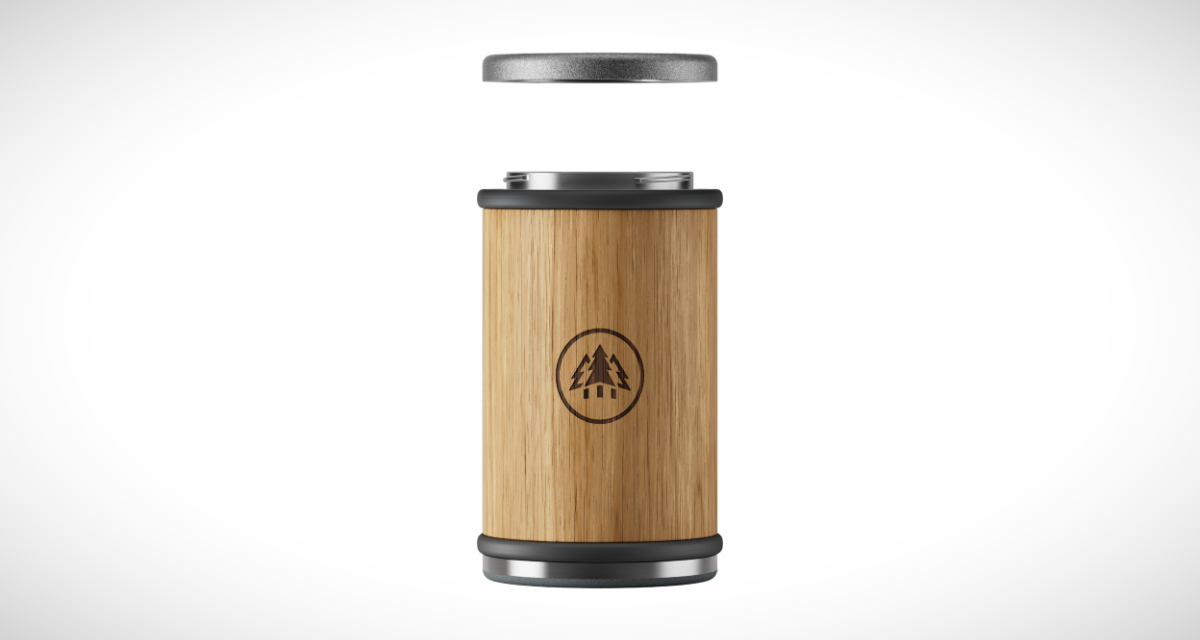
The material language reinforces the philosophy. HORL models use materials including solid oak and walnut, while later versions introduce aluminium and recycled materials. The wooden body gives the tool a tactile, domestic character that changes how a traditionally utilitarian object occupies the kitchen.
User experience is partly psychological. A tool that feels precise, stable, and worth caring for invites regular maintenance. The HORL Knife Sharpener does not simply perform sharpening. It makes sharpening feel like an intelligible act.
From Whetstone to Rolling Mechanism
The history of sharpening is a history of controlled abrasion. Long before branded kitchen systems, blades were maintained with naturally occurring stones, oilstones, waterstones, honing steels, and increasingly specialized abrasive materials. The basic principle remained stable: remove or realign material at the edge until the blade regains a useful geometry.
What changed over time was the distribution of skill.
A whetstone places considerable responsibility on the user. A honing rod depends on practiced coordination. Guided systems introduced jigs, clamps, or fixed angles to reduce variation. Electric sharpeners went further by enclosing the abrasive process inside a machine.
The HORL belongs to another branch of this evolution. It does not hide the sharpening process, nor does it demand the full discipline of traditional stone work. Instead, it externalizes the critical geometry through a physical guide and converts the abrasive motion into rolling.
That distinction is important. The innovation is not simply that the abrasive element rotates. Rollers and rotary abrasives have existed in countless forms. The design achievement comes from organizing the entire interaction around the rolling gesture.
The father-and-son origin of the product is also revealing. HORL describes Otmar and Timo Horl as combining design and engineering expertise when they developed the first rolling sharpener in 2016. Such collaboration points toward a broader principle of industrial design: successful products often emerge when mechanical feasibility and human behaviour are considered together, rather than in sequence.
In that sense, the HORL asks a deceptively difficult question: what part of expertise can the object carry on behalf of the user?
HORL Knife Sharpener Designing the Gesture
Good industrial design often begins with a movement rather than an appearance. The HORL is a particularly clear example.
Place the magnetic support against the blade. Position the knife. Set the rolling cylinder onto the edge. Move it along the blade. Repeat. Change the abrasive disc when necessary. The sequence is almost choreographic.
The rolling motion gives the body a natural role. A cylindrical object invites the hand to push and retrieve. Its circular geometry makes the direction of movement obvious. Meanwhile, the knife remains stationary, reducing one source of instability.
This is affordance made visible. The object communicates how it should be used through its geometry.
The abrasive system adds another layer of differentiation. HORL2 uses a diamond grinding disc for initial sharpening and a ceramic honing disc for refining the edge and removing the burr. The discs are interchangeable, and later HORL generations use a Quick Lock mechanism for disc changes. The result is a modular architecture in which the core body remains the stable centre of the system while its working surfaces can evolve.
That is a subtle but powerful strategy for longevity. A product becomes more resilient when its identity does not depend on every component remaining fixed forever.
The HORL2 Pro develops this philosophy further with internal planetary gearing that increases the rolling transmission ratio and speeds up sharpening. Here, engineering is not added for spectacle. It modifies the effort required to achieve the same task.
The best mechanical details often behave this way. They are experienced as ease rather than observed as technology.
Why the HORL Knife Sharpener Is a Time-Proof Design
A time-proof design must survive changes in taste, technology, and daily behaviour. The HORL Knife Sharpener has several characteristics that make that possible.
First is clarity. Its essential idea can be explained in a sentence and understood through one physical demonstration. This gives the design conceptual stability. New versions may alter materials, discs, mechanisms, or finishes, but the fundamental proposition remains recognisable.
Second is mechanical legibility. The rolling body, angle support, magnetic hold, and abrasive disc each have a distinct role. Nothing essential is buried behind a screen or dependent on software. The product remains understandable because its function is materially expressed.
Third is maintenance rather than replacement. A sharpener exists to extend the useful life of another object. That creates an unusual ecological logic. Its value depends partly on helping knives remain functional for longer, rather than encouraging a cycle of disposal and acquisition.
Fourth is restrained visual identity. The wooden versions have a tactile, domestic quality that connects with the material culture of the kitchen. Wood ages. Aluminium develops a different character. Neither depends entirely on a passing visual fashion. HORL itself frames its products around durability and long-term use, describing its products as built for a lifetime.
These qualities echo durable principles associated with twentieth-century industrial design: form should clarify function, technology should serve use, and products should resist unnecessary novelty.
The HORL Knife Sharpener adds another principle to that tradition: precision can be democratized through physical guidance.
A Domestic Object with Professional Ambition
The contemporary kitchen has changed dramatically. Professional tools have entered domestic life through specialist cookware, espresso machines, induction appliances, fermentation equipment, and increasingly sophisticated knives.
Yet expertise can create a strange barrier. The more serious the tool, the greater the expectation that the owner should already know how to use it.
The HORL Knife Sharpener addresses that tension elegantly. It accepts the growing sophistication of kitchen knives while reducing the intimidation associated with maintaining them.
Its current product family makes the strategy visible. HORL offers rolling sharpeners with combinations of 15° and 20° angles, diamond and ceramic discs, and, in more advanced models, additional angle and transmission options. The ecosystem has also expanded into docks, accessories, and newer generations of the sharpening system.
This creates a product language closer to a tool system than a singular gadget.
That distinction matters in an era of accelerated consumer electronics. A connected appliance may become obsolete when its software, operating system, or battery architecture changes. The HORL depends primarily on physical relationships that remain intelligible. A knife has an edge. An abrasive surface alters that edge. An angle determines the geometry. A hand supplies motion.
Those fundamentals are unlikely to become obsolete.
The Future of Sharpening Is Still Physical
The future relevance of the HORL Knife Sharpener may seem paradoxical. As kitchens become increasingly automated, why would a manually operated sharpening tool matter more?
Precisely because automation does not eliminate the value of tactile interaction. In a highly mediated domestic environment, objects that offer direct physical feedback can become increasingly meaningful.
The HORL also has a strong platform logic. Its rolling architecture can accommodate different abrasive surfaces, angle systems, materials, and mechanical refinements without abandoning the central gesture. The current HORL3 Pro, for example, expands the system to six sharpening angles, while other HORL3 models use exchangeable discs and newer locking mechanisms.
This suggests a future in which the core object remains familiar while its capabilities evolve.
That is one of the clearest forms of time-proof design. Longevity does not require freezing an object in its original state. It requires building an architecture capable of accepting improvement without losing identity.
The HORL Knife Sharpener ultimately succeeds because it understands sharpening as a design problem rather than merely an abrasive one. It gives geometry a physical guide, gives the hand a comprehensible movement, and gives a specialist task a domestic scale.
There is an almost philosophical elegance in that approach. The product does not attempt to erase the craft of sharpening. It creates an accessible bridge toward it.
A knife edge is only a few millimetres wide, yet maintaining it connects material science, mechanics, human skill, and everyday ritual. The HORL makes those relationships tangible. Its enduring quality lies there: a simple mechanical idea, shaped around human behaviour, with enough technical depth to remain useful as the surrounding world changes.
That is what makes the HORL Knife Sharpener a compelling example of Time-Proof Design.