
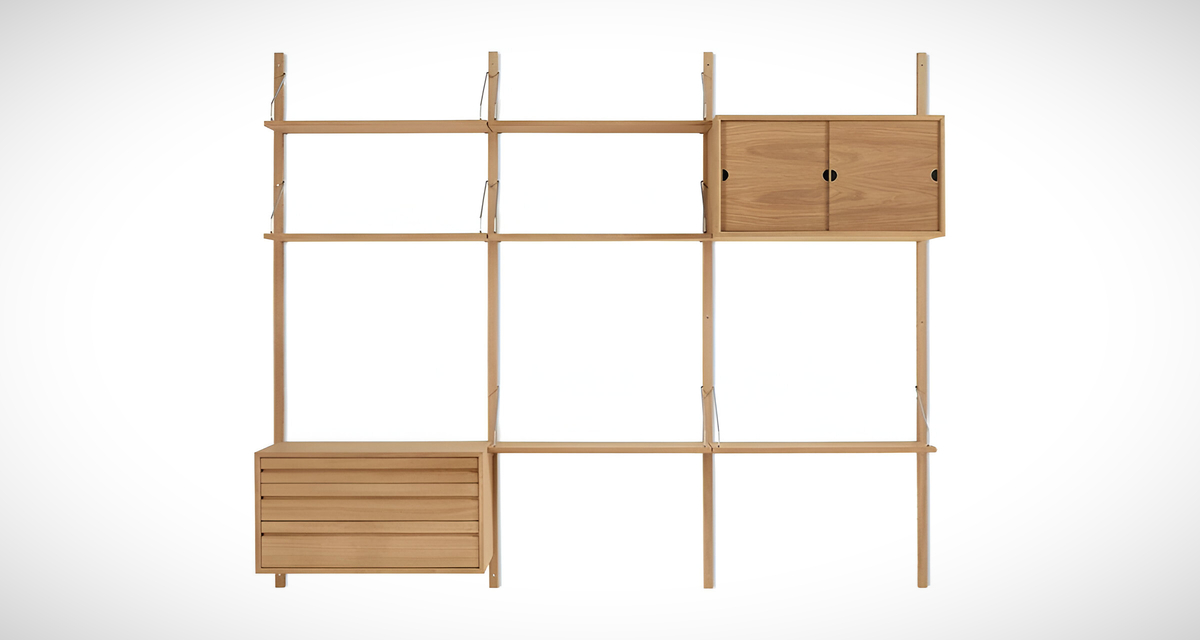
The Royal System Shelving Design is one of the most enduring pieces of modern furniture ever created. Introduced in 1948 by Danish designer Poul Cadovius, this wall-mounted shelving system transformed the way people thought about living spaces, storage, and interior aesthetics. What makes it remarkable is not only its beauty or craftsmanship, but also its ability to stay relevant across more than seven decades of shifting tastes and lifestyles.
At a time when many furniture designs fade into obsolescence, the Royal System continues to stand strong as a time-proof masterpiece. It represents more than a shelving unit: it is a statement about functionality, adaptability, and timeless design thinking. From its roots in mid-century Danish Modernism to its presence in today’s homes and workspaces, it is proof that design can achieve something extraordinary when it balances practicality with elegance.
In this article, we will trace the history of the Royal System, explore the design concept that made it revolutionary, examine its cultural heritage within Danish design, highlight iconic models, and explain why it will remain timeless and relevant well into the future.
The Historical Context: Why 1948 Was the Right Moment
The Royal System emerged in a Europe recovering from the devastation of the Second World War. The post-war period demanded solutions that reflected practicality, efficiency, and lightness. People lived in smaller homes, and traditional heavy furniture no longer suited the new ways of life.
Denmark, already at the forefront of functionalist architecture and furniture, was the perfect breeding ground for innovation. Poul Cadovius recognized that furniture had to adapt to modern homes rather than dominate them. The Royal System was his response: a shelving design that freed the floor space, offered flexibility, and created visual lightness.
Unlike the ornate and rigid furniture of the past, Cadovius envisioned a system that would float on walls, leaving floors uncluttered. This wall-mounted design was groundbreaking because it challenged the very idea of what storage should look like. By eliminating the need for bulky cabinets, he created something modular and adaptable, a concept that would influence decades of design.
The Core Concept of the Royal System Design
At first glance, the Royal System seems deceptively simple: wooden wall brackets, metal or brass supports, and interchangeable shelves or cabinets. Yet, this simplicity hides an ingenious design philosophy. The system embodies three fundamental ideas:
- Flexibility
Every shelf or cabinet can be repositioned. Users are not locked into one configuration but can constantly adapt the system to changing needs. A family could start with a few shelves in a living room, then add a writing desk or a bar cabinet later, showing how the system evolves alongside life. - Modularity
Unlike traditional storage units, which impose a fixed design, the Royal System is modular and allows infinite combinations. Shelves can be arranged horizontally or vertically, cabinets can be mixed in, and the system can expand indefinitely. - Aesthetic Restraint
By stripping the design to its essentials, Cadovius achieved a balance between function and beauty. The fine woods, teak, oak, or rosewood, added warmth, while the precision of the brackets and supports gave it structural clarity. The result was furniture that blended seamlessly into different architectural contexts, from post-war apartments to modern lofts.
This balance of form and function was not just a design move, it was a cultural shift. Furniture was no longer static. It became dynamic, personal, and adaptable.
Danish Modern Heritage: A Movement of Timeless Design
The Royal System cannot be separated from the larger story of Danish Modern design, which flourished between the 1940s and 1960s. Alongside iconic creations by Hans J. Wegner, Arne Jacobsen, Børge Mogensen, and Finn Juhl, Cadovius’ shelving system represented a new vision of how design should serve daily life.
Danish Modern was about simplicity, natural materials, and democratic accessibility. The Royal System reflects this ethos perfectly. While it was crafted from high-quality woods and metals, its design remained free of ostentation, making it accessible to a broad audience. Its modular nature made it adaptable not just for affluent homeowners but for anyone seeking functional beauty.
This democratic spirit, coupled with exceptional craftsmanship, ensured that the Royal System became not just a product but a cultural emblem of post-war optimism and innovation.
Timeless Models That Define the Royal System Shelving Design
Throughout its history, several models and variations of the Royal System stand out as classic examples of enduring design:
- The Original 1948 Teak Model
The very first edition in warm teak wood remains highly collectible today. Its brass brackets, clean lines, and elegant proportions capture the spirit of mid-century modern interiors. - Cabinet and Desk Modules
With sliding doors, drop-down desks, or bar units integrated seamlessly into the shelving structure, these models illustrate how the Royal System anticipated multifunctional living long before it became a design trend. - 1960s and 1970s Oak Editions
As lighter interiors gained popularity, oak versions provided a fresh take on the system. Their neutral tones fit perfectly with Scandinavian minimalism, making them highly versatile. - Contemporary Reissues by DK3
Today, Danish brand DK3 produces new editions of the Royal System, preserving its original integrity while incorporating modern sustainability standards. These reissues ensure the design remains accessible and relevant in contemporary homes.
Each of these variations demonstrates the continuity of Cadovius’ vision, proving that the system can evolve with the times while retaining its essence.
Why the Royal System is Time-Proof
Very few designs can claim to be immune to trends. Yet the Royal System has proven its relevance for over seven decades. Here is why it remains a time-proof design:
- Universal Adaptability
Whether installed in a 1950s Danish apartment, a 1980s industrial loft, or a 2020s minimalist studio, the Royal System always feels at home. Its visual neutrality allows it to blend into any context. - Sustainable Longevity
Unlike disposable furniture, the Royal System is built to last. Many mid-century units are still in use today, proving that high-quality materials and craftsmanship are inherently sustainable. - Alignment with Modern Aesthetics
The rise of Scandinavian minimalism and contemporary design philosophies only strengthens the appeal of the Royal System. What was radical in 1948 feels just as relevant in modern homes. - Emotional Connection
Because the system grows with its users, it often becomes part of their personal history. Families pass down units across generations, making the furniture not just functional but sentimental.
The combination of adaptability, durability, and emotional value ensures that the Royal System remains timeless.
The Future of the Royal System Shelving
Looking forward, the Royal System will continue to thrive for several reasons:
- Urban Living Demands
With global urbanization, smaller apartments and flexible interiors require adaptable furniture. The Royal System provides exactly that. - Sustainability as a Priority
Consumers increasingly demand long-lasting and environmentally responsible furniture. By lasting decades, the Royal System supports a circular economy. - Cross-Generational Appeal
Vintage collectors prize original models, while younger generations embrace reissues for their authenticity and heritage. This ensures continued demand. - Customization Culture
Modern consumers seek furniture that reflects individuality. With its modular design, the Royal System offers endless opportunities for personal expression.
In essence, the Royal System is not only relevant today but positioned to remain a design essential for decades to come.
Conclusion: A Legacy That Lives On
The Royal System Shelving Design is far more than a shelving unit. It is a living embodiment of design intelligence, cultural heritage, and timeless adaptability. From Poul Cadovius’ 1948 vision to contemporary interiors, it has consistently shown that furniture should not only serve function but also enrich daily life with beauty and flexibility.
Few designs achieve such lasting impact. The Royal System does so because it respects human needs, adapts to changing lifestyles, and embodies craftsmanship that withstands time.
Whether displayed in vintage teak, modern oak, or reissued in sustainable materials, the Royal System continues to inspire designers, homeowners, and collectors around the world. Its legacy is not confined to the past; it is part of the future of modern living.
In a world filled with fleeting trends, the Royal System stands as a permanent icon of timeless design.