
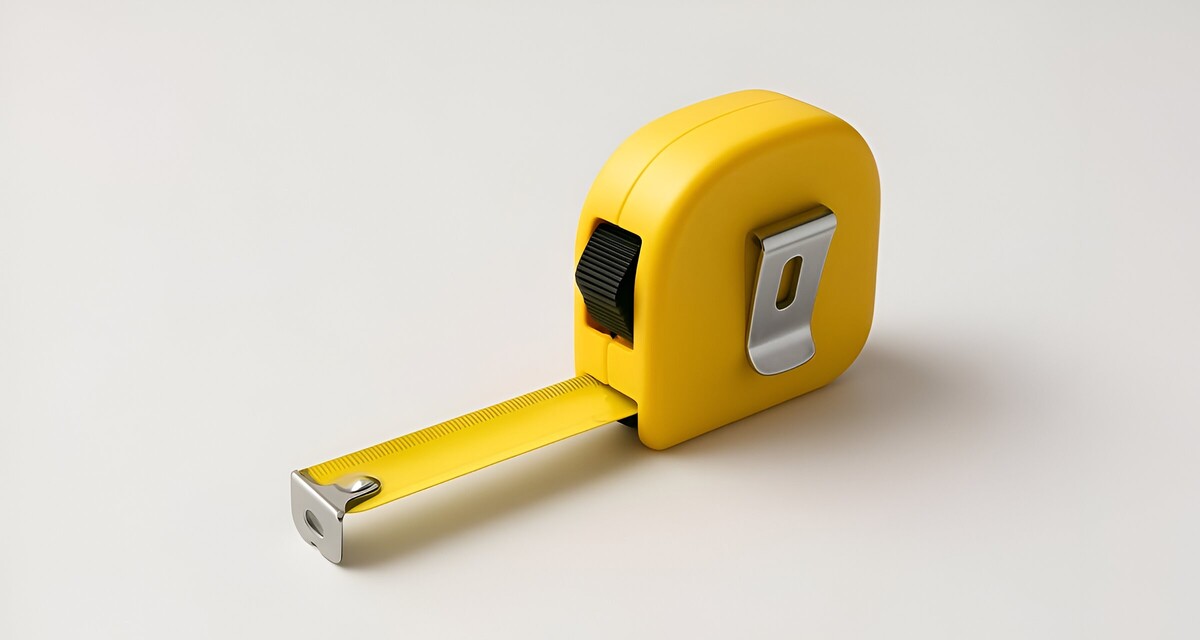
This compact tool, the retractable tape measure, tucked into toolboxes and worn on belts across the planet, is far more than a strip of marked metal. It’s a piece of design history that captures human ingenuity, precision, and practical thinking. The retractable tape measure has evolved through centuries of craftsmanship and innovation, becoming a true model of timeless industrial design.
At its essence, the retractable tape measure is a perfect balance of simplicity and functionality. A thin, flexible strip extends to measure, locks into position for accuracy, and retracts neatly back into its housing. The beauty of this design lies in its mechanical logic: everything serves a purpose, nothing is superfluous. Its appeal is universal because it fulfills one of humanity’s most constant needs, measuring and defining space, with efficiency, durability, and elegance.
Retractable Tape Measure Origins and Early Heritage
Before the tape measure as we know it, artisans and builders relied on cloth, rope, or folding rulers. Early tailors used soft linen tapes, often marked by hand, while surveyors employed cumbersome chains and rods. These tools worked, but they lacked precision, durability, and portability.
That changed in 1829, when James Chesterman, a Sheffield metalworker, invented the first spring-loaded steel measuring tape. Chesterman’s innovation came from a clever moment of repurposing: he adapted flat steel wire originally used for women’s hoop skirts and turned it into a coiled measuring ribbon. By adding a spring mechanism and marking precise measurements on the metal surface, he created a compact and reliable tool for surveyors and builders. His design was sold as a “Steel Band Measuring Chain,” and though it was expensive for its time, it laid the groundwork for modern measurement tools.
The Industrial Age of Measuring Tools
Several decades later, in 1868, Alvin J. Fellows, an inventor from Connecticut, revolutionized the concept again. His patented design introduced a spring-click locking mechanism that allowed the tape to stay extended without manually holding it in place. This breakthrough made it far more convenient for builders and craftsmen, turning it from a specialist’s tool into an everyday essential.
Through the late 19th and early 20th centuries, manufacturers such as Lufkin, Stanley, and Stabila refined the design even further. The tapes became stronger, longer, and easier to read. In 1922, the concave-convex form of the measuring blade was introduced, a seemingly small innovation that allowed the strip to extend several meters without bending. This change transformed usability, giving workers a “stand-out” tape that could span longer distances with accuracy and stability.
By mid-century, the retractable tape measure had become a global standard. Its design language, bright case, visible markings, and solid mechanical feel, entered both professional toolkits and household drawers.
Why the Retractable Tape Measure Design Is Time-Proof
Few products embody time-proof design as perfectly as the retractable tape measure. Its staying power rests on several core principles that blend practical utility with enduring design philosophy.
1. A permanent purpose. Measuring length, width, and height is a universal human need. No matter how technology evolves, physical measurement remains fundamental to construction, design, and daily life. Because that function never disappears, the tape measure never loses relevance.
2. Elegant mechanical simplicity. Inside its small housing lies a system of ingenious parts: a flat spring reel, a flexible metal tape, a locking device, and a protective case. Together, they achieve mechanical harmony without complexity. The retractable spring allows easy storage, while the lock mechanism holds measurements firmly, simple, effective, and repairable.
3. Iterative evolution. The tape measure hasn’t needed radical reinvention, only refinement. Improvements in material strength, print clarity, and ergonomic form have elevated the design while maintaining the same essence for nearly two centuries.
4. Intuitive ergonomics. From the curve of the casing to the placement of the lock button, every feature has evolved around human interaction. The design feels instinctive, users can operate it confidently with one hand, guided by tactile feedback and visual clarity.
5. Adaptability across trades and cultures. Builders, designers, engineers, tailors, and homeowners all rely on the same tool. Its design transcends industries and languages, a hallmark of universality in design.
The retractable tape measure, in its perfection of simplicity, proves a profound design truth: when a product fulfills its purpose with minimal waste, it achieves longevity far beyond trends or technology cycles.
Retractable Tape Measure Design Concept and Approach
From a product design perspective, the retractable tape measure represents an ideal study in functional aesthetics, where every part contributes to both utility and experience.
Defining form and function. The essential components include the measuring blade, spring mechanism, lock system, casing, and hooked end. Each element is shaped by physical laws and human needs. The tape must be flexible enough to coil, yet rigid enough to stand out, the spring must retract smoothly, yet with enough tension to feel controlled. These requirements drive every design decision, from material thickness to curvature radius.
Materials as design evolution. The early cloth and wire gave way to hardened spring steel, which remains the standard. Modern alloys now resist bending, warping, and corrosion. Coatings prevent rust and increase contrast, while etched or printed markings ensure legibility. The outer housing, once leather or wood, evolved into metal, then impact-resistant ABS plastic, and now sometimes hybrid materials for balance between toughness and weight.
Ergonomics, Mechanics and User Experience
Mechanical integrity. At its heart, the retractable tape measure is a dance of forces, tension, release, and resistance. The internal spring must coil tightly yet remain smooth after thousands of uses. The locking mechanism must engage with precision but release effortlessly. The best designs strike that balance, turning a utilitarian mechanism into a tactile experience.
Ergonomics and interaction. Designers have refined the casing shape to fit the curve of the human hand. The lock button sits where the thumb naturally falls, enabling quick action. Belt clips allow easy access, and non-slip grips improve control even with gloves. Such details demonstrate deep empathy for real-world users.
Visual clarity and usability. The high-contrast yellow background with black and red markings isn’t an accident, it’s the result of decades of testing for readability under varied light conditions. Many tapes feature dual-unit markings for metric and imperial systems, reinforcing global versatility.
Durability and maintenance. A quality tape measure must survive drops, impacts, moisture, and dust. Reinforced cases, shock-resistant mechanisms, and corrosion-proof blades are now industry norms. The floating hook at the tape’s end, riveted and slightly movable, compensates for its own thickness, ensuring accurate readings whether pulling from an edge or pushing into a corner.
Each detail, from grip texture to hook design, contributes to a seamless user experience. Together they create a design language of reliability, refined by countless hands over more than a century.
Why It Will Remain Timeless and Future-Relevant
As technology advances, one might assume that traditional tools like the tape measure would fade. Yet the opposite is true. The retractable tape measure design continues to thrive because it satisfies something fundamental: the human desire for direct, tactile connection with the physical world.
Immediate feedback and control. Digital devices can calculate and record, but the tape measure gives something different, instant, physical verification. You feel the extension, see the measurement, and hear the soft click as it locks in place. It’s sensory, immediate, and deeply satisfying.
Universality and accessibility. The tape measure is affordable, reliable, and globally understood. No batteries, no Wi-Fi, no calibration, just a self-contained instrument that works anywhere. That democratic accessibility keeps it indispensable in every industry.
Design Longevity and Future Adaptations
Technological harmony. Rather than being replaced by digital tools, the tape measure coexists with them. Modern models incorporate digital readouts, laser-assisted accuracy, or even Bluetooth connectivity to record data. Yet the fundamental mechanism remains unchanged. That blend of mechanical reliability and technological enhancement ensures its continued evolution without eroding its character.
Sustainable philosophy. In an era focused on sustainability, the mechanical nature of the retractable tape measure feels refreshing. It produces no electronic waste, has a long service life, and often uses recyclable materials. Its durability aligns naturally with sustainable design values.
Cultural and symbolic endurance. Beyond utility, the tape measure has become a symbol of craft, precision, and practicality. It represents the builder’s mindset, the balance between imagination and accuracy. Even in digital workshops, the simple act of pulling a tape to verify a dimension remains a universal gesture of confidence.
Continuity and trust. The most enduring designs connect past and present through familiarity. Pick up a tape measure from fifty years ago, and its operation feels the same as one made today. That sense of continuity builds emotional trust and reinforces its timeless identity.
Future potential. The coming years will bring materials like carbon-fiber blades, recycled casings, and smart connectivity. Yet even as features evolve, the retractable mechanism, the heart of the design, will remain untouched. This adaptability, combined with its universal utility, ensures its relevance for generations to come.
Final Thoughts
The retractable tape measure is a rare creation: a simple tool that captures the essence of design intelligence. From James Chesterman’s 19th-century innovation to today’s precision-engineered models, every iteration has deepened its value without diluting its identity.
Its longevity comes not from trend or branding, but from pure design logic. The action of extending, locking, reading, and retracting feels intuitive because it mirrors the rhythm of human use. The tool becomes an extension of the user’s intent, a silent partner in creation, building, and problem-solving.
In an age defined by rapid technological change, the retractable tape measure remains reassuringly constant. It reminds us that progress doesn’t always mean complexity, sometimes, perfection is found in simplicity refined over time.
Whether you’re a builder marking a frame, a designer prototyping a concept, or a homeowner hanging a picture, every pull of the tape connects you to two centuries of human craftsmanship and creativity. It’s a design heritage and a symbol of timeless utility design.
And that is why the retractable tape measure will never fade. It will continue to measure not only distances but the enduring reach of thoughtful design itself.